

Every English learner (and plenty of native speakers) hits this fork in the road eventually: do you say “Can I leave early?” or “May I leave early?” Both feel right. Both get used every day. But they don’t mean exactly the same thing — and knowing the difference can make your writing sound sharper, more polite, and more precise.
This guide breaks down everything you need to know about may vs can, from formal grammar rules to real-world examples, so you never second-guess yourself again.
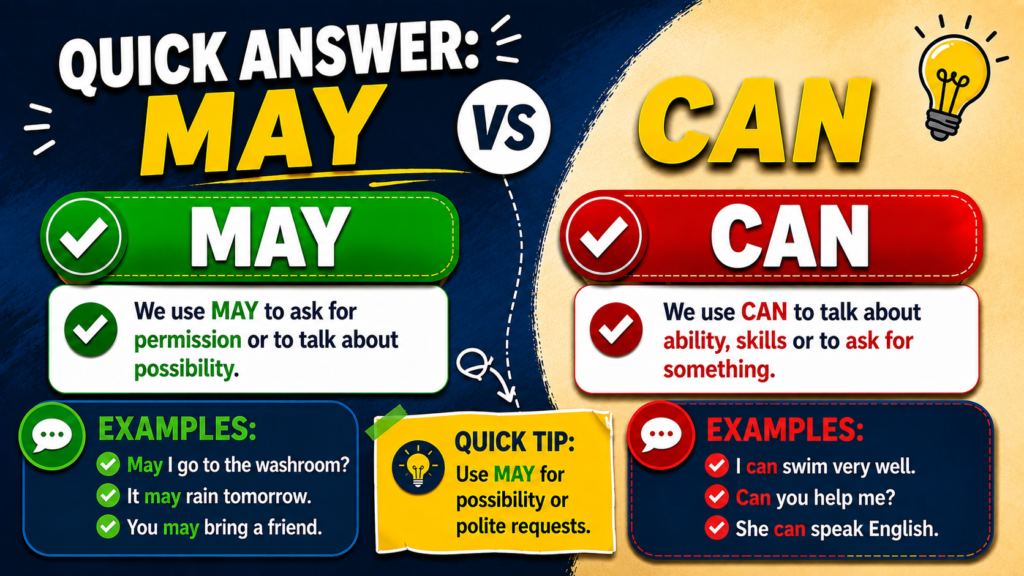
Quick Answer: May vs Can
| Can | May | |
|---|---|---|
| Main use | Ability or capability | Formal permission or possibility |
| Tone | Casual, everyday | Polite, formal |
| Common in | Speech, informal writing | Formal writing, official requests |
| Example | I can swim. | You may leave now. |
In short: “can” talks about what’s possible or what someone is able to do, while “may” talks about permission or a formal chance of something happening. In casual conversation, though, the two often overlap — which is exactly why the confusion happens.
Understanding the Basics of May vs Can
Both “can” and “may” are modal verbs (also called helping or auxiliary verbs). That means they don’t work alone — they pair with another verb to add meaning about ability, permission, possibility, or necessity.
- She can drive. (ability)
- She may drive if the roads are clear. (possibility)
- You may drive my car. (permission)
The Core Difference
Historically, English teachers drew a hard line:
- Can = physical or mental ability
- May = permission or possibility
That rule still shows up in classrooms today (“Can I go to the bathroom?” “I don’t know — can you?”). But modern usage has blurred the edges. In spoken English, “can” is now widely accepted for permission too. “May,” on the other hand, has held onto its formal, slightly old-fashioned charm.
Correct Meanings and Uses
Using “May” for Permission
“May” is the gold standard when you want to sound polite, respectful, or official. It’s the word you’ll find in legal documents, workplace emails, and classroom instructions.
Examples:
- May I ask you a question?
- Students may leave once the exam ends.
- You may proceed to the next section.
Test Tip 💡
On grammar exams (TOEFL, IELTS, SAT), examiners often prefer “may” for permission questions because it’s considered the technically correct, formal choice.
Using “May” to Express Possibility
“May” also signals that something is likely but not certain — a softer cousin of “might.”
Examples:
- It may rain later today.
- The meeting may be postponed.
- She may already know the answer.
Sentence Breakdown
In “It may rain later today,” the speaker isn’t stating a fact — they’re hedging. Swap in “can,” and the sentence stops making sense (“It can rain later today” sounds like a general truth about weather, not a specific forecast).
Using “Can” for Ability
“Can” is your go-to word for describing skills, capabilities, or what’s physically or technically possible.
Examples:
- He can speak three languages.
- This car can reach 200 km/h.
- I can finish the report by Friday.
Sentence Breakdown
“I can finish the report by Friday” is about capacity, not permission. Nobody is granting approval here — the speaker is simply stating what they’re capable of doing.
Test Tip 💡
If you can replace the word with “am able to” and the sentence still makes sense, “can” is the correct choice.
Using “Can” for Informal Permission
In everyday speech, “can” is completely normal for asking permission — it’s just less formal than “may.”
- Can I borrow your pen?
- Can we leave early today?
- You can sit here if you want.
Comparing May and Can Side by Side
| Feature | Can | May |
|---|---|---|
| Ability | ✅ Yes | ❌ No |
| Permission (formal) | ⚠️ Acceptable, informal | ✅ Preferred |
| Permission (casual) | ✅ Standard | ⚠️ Sounds stiff |
| Possibility | ❌ Rare | ✅ Yes |
| Used in legal/official text | ❌ Rare | ✅ Common |
| Everyday speech | ✅ Very common | ⚠️ Less common |
Case Study: Workplace Email
Word choice changes the tone of an entire message. Compare these two versions of the same request.
Email Version 1
“Hi Sarah, can I take next Friday off? I have a family event.”
Email Version 2
“Hi Sarah, may I take next Friday off? I have a family event.”
Which One Is Better?
Both are grammatically fine. Version 1 feels friendly and casual — good for a coworker you know well. Version 2 feels more formal and respectful — better suited for a manager, HR request, or someone you don’t know well. Neither is “wrong”; it’s about matching tone to context.
Real-Life Conversation Example
Teacher: Can I help you with something? Student: May I ask a question about the homework?
Notice how the teacher uses “can” casually, but the student — asking for permission in a slightly more formal, respectful context — reaches for “may.” This kind of natural code-switching happens constantly in real conversations.
Grammar Rules Explanation
Rule 1
Use “can” when referring to ability, skill, or capacity — physical, mental, or technical.
Rule 2
Use “may” when referring to formal permission or a genuine possibility that something might happen.
Rule 3
In informal speech and writing, “can” is widely accepted for permission. In formal writing (legal, academic, business), stick with “may.”
Common Mistakes
Common Errors
Incorrect: She may lift 50 kilograms easily. (This is about ability, not permission or possibility.) Correct: She can lift 50 kilograms easily.
Incorrect: Can I please have your permission to leave the building? (Mixing an informal modal with a very formal request sounds inconsistent.) Correct: May I please have your permission to leave the building?
Incorrect: You can be right about this. (In this context, the speaker means “possibly,” which calls for “may” or “might.”) Correct: You may be right about this.
Similar Grammar Confusions
If “may vs can” tripped you up, these related pairs are worth knowing too:
- May vs Might — “may” suggests a stronger likelihood; “might” suggests something more uncertain or hypothetical.
- Could vs Can — “could” is often more polite or hypothetical; “can” is direct and present-tense focused.
- Can vs Be Able To — “be able to” works in tenses where “can” doesn’t (like the future or perfect tense).
Usage in Different Contexts
Everyday Conversation
“Can” dominates casual speech — for both ability and permission. “May” can sound overly formal among friends.
Professional Writing
“May” is preferred in emails, policies, and official communication where tone and respect matter.
Academic Writing
Academic papers often use “may” to express possibility or hedge a claim (“Results may indicate a correlation…”).
Creative Writing ✍️
Fiction writers mix both freely, choosing whichever word fits a character’s voice — formal narrators may lean on “may,” while casual dialogue leans on “can.”
Social Media and Texting 📱
“Can” wins almost every time — it’s short, casual, and matches the tone of quick digital messages.
Why It Matters 🌟
Clarity
Choosing the right modal verb helps your reader instantly understand whether you’re talking about ability, permission, or possibility.
Professionalism
Using “may” in formal settings signals politeness and attention to tone — small details that shape how others perceive your writing.
Digital Communication
As writing increasingly happens over chat, email, and social media, understanding when to relax formality (with “can”) versus when to elevate it (with “may”) keeps your communication appropriate for the platform.
Special Exceptions
Some fixed phrases and idioms don’t follow the usual rules — “May I have this dance?” is a set formal phrase, while “Can do!” is a fixed casual expression. These exceptions are learned through exposure rather than strict grammar logic.
Quick Recap Checklist ✅
- ✅ Use can for ability, skill, or capacity
- ✅ Use may for formal permission
- ✅ Use may for possibility or likelihood
- ✅ Use can for informal, everyday permission requests
- ✅ Match your word choice to the formality of the situation
Practice Examples
Example 1
_____ you swim across the lake? (ability) → ✔️Can
Example 2
_____ I please use your phone, sir? (formal permission) → ✔️ May
Example 3
It _____ snow tonight, according to the forecast. (possibility) → ✔️ May
Memory Trick 🧠
Think: “Can” = Capability. “May” = Manners. If you’re talking about what someone is able to do, reach for “can.” If you’re being polite or unsure, reach for “may.”
Frequently Asked Questions: May vs Can
Is it grammatically correct to say “Can I go to the bathroom”?
Yes, it’s grammatically correct and widely accepted, though “May I” is considered more formal and polite.
Can “may” and “can” be used interchangeably?
In casual speech, often yes — especially for permission. In formal writing, they carry different levels of politeness.
Which one should I use in a business email?
Use “may” for formal requests and “can” for casual, everyday workplace communication.
Is “may” always more polite than “can”?
Generally yes, especially when asking for permission in professional or unfamiliar settings.
Does “can” ever express possibility?
Rarely, and usually in general statements (“Accidents can happen”), not specific predictions — “may” is the better choice there.
What’s the difference between “may” and “might”?
“May” suggests a stronger chance of something happening, while “might” implies more uncertainty or a hypothetical situation.
