

You’re typing an email and stop mid-sentence. ⌨️ Should it be “most important” or “most importantly”? 🤷 Both look right, and both show up in print all the time. 📰 This guide explains the difference between most important and most importantly in plain English. ✅ You’ll get simple rules, real examples, and a few shortcuts to pick the right one fast. 🎯
Quick Answer: Most Important vs Most Importantly
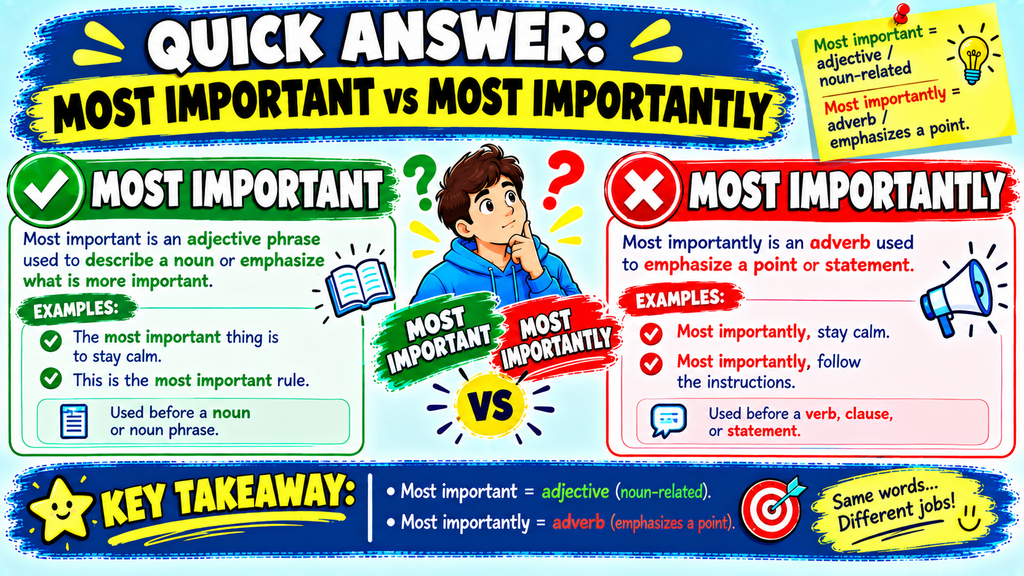
Most important is an adjective phrase that describes a noun, as in “the most important rule.” 📏 Most importantly is an adverb that introduces or stresses a key point, as in “Most importantly, stay calm.” 🔦 At the start of a sentence, both are widely accepted, though some style guides prefer “most important.” ✍️
| Feature | Most Important | Most Importantly |
|---|---|---|
| Part of speech | Adjective | Adverb |
| Job in a sentence | Describes a noun | Stresses a whole point |
| Typical spot | Before a noun or after “is” | Start or middle of a sentence |
| Example | The most important step is rest. | Most importantly, get some rest. |
Memory trick: Most important is a label. Most importantly is a spotlight. 💡
Understanding the Basics: Most Important vs Most Importantly
Both phrases come from the same root word, important. 🌱 The only change is the ending, and that ending changes the job. 🔧
The adjective important describes things. 📦 The adverb importantly describes how or why a statement matters. 🧭 Grammar books call the second use a sentence adverb, because it comments on the whole sentence instead of one word. 📚
Understanding “Most Important”
“Most important” is the superlative of the adjective important. 🏆 It points to the top item in a group. 🥇 You’ll usually see it before a noun, after a linking verb, or inside a clause like “what is most important.” 🔗
- “The most important factor is trust.” 🤝
- “Safety is most important.” 🦺
- “What is most important is that you try.” 💪
Test Tip: If you can add “thing” after it, use most important. ✅
Understanding “Most Importantly” ✍️
“Most importantly” is the superlative of the adverb importantly. 🏅 It doesn’t name the key point. 🚫 It announces that the point coming next matters more than everything before it. 📢
- “Most importantly, check your spelling.” 🔍
- “She is smart and, most importantly, kind.” 💛
Test Tip: If you can swap in “above all,” use most importantly. ✅
Correct Meanings and Uses
Use “Most Important” When Describing a Thing
Choose this form whenever a noun is involved. 🧱 It tells readers which item ranks first. 🎖️
- “The most important rule is honesty.” 🧭
- “Sleep is the most important part of recovery.” 😴
- “That was the most important meeting of the year.” 📅
Use “Most Importantly” When Emphasizing a Point
Choose this form to introduce a final or top-priority idea. 🎤 It works well in lists, advice, and conclusions. 📝
- “Most importantly, back up your files.” 💾
- “Eat well, sleep early, and, most importantly, enjoy the process.” 🌿
Both Can Work in Some Sentences
At the very start of a sentence, many writers use either form. 🔄
- “Most important, keep the receipt.” 🧾
- “Most importantly, keep the receipt.” 🧾
The first is a shortened version of “what is most important.” ✂️ The second treats the phrase as a sentence adverb. 🎯 Both are in print, so the choice often comes down to tone and your style guide. 📖
Case Study Section: One Messy Email
Here is a made-up scenario. 📝 Daniel drafts a project update and a colleague edits it. ✉️
| Daniel’s Draft | The Problem | Edited Version |
|---|---|---|
| “Most importantly thing is the deadline.” | An adverb can’t describe a noun. | “The most important thing is the deadline.” |
| “The most importantly factor is cost.” | Same problem, plus an adverb before a noun. | “The most important factor is cost.” |
| “Most importantly keep the client updated.” | The comma is missing. | “Most importantly, keep the client updated.” |
The lesson is simple. 💡 Use the adjective with nouns and the adverb to spotlight a point. 🔦 Most mistakes come from mixing those two jobs. 🔀
Grammar Rules Explanation
Follow these rules and you’ll rarely go wrong. 👇
- Adjective before a noun: “the most important step.” 🪜
- Adjective after a linking verb: “Honesty is most important.” 🤝
- Adverb at the start: use a comma. “Most importantly, listen.” 👂
- Adverb in the middle: wrap it in commas. “He is quick and, most importantly, careful.” 🐢
- Never put the adverb before a noun: “the most importantly rule” is wrong. ❌
- Keep “the” with the noun: “the most important thing,” not “most important thing.” 🔤
- Comparing two things: use “more important” or “more importantly.” ⚖️
One more tip: the adverb alone also works as a sentence opener, as in “Importantly, sales grew.” 📈 The adjective alone doesn’t, so “Important, sales grew” is wrong. 🚫
Common Mistakes
| Mistake | Why It’s Wrong | Correct Version |
|---|---|---|
| “The most importantly reason is price.” | An adverb can’t modify a noun. | “The most important reason is price.” |
| “Cost is most importantly.” | “Importantly” can’t follow “is” this way. | “Cost is most important.” |
| “Most importantly stay calm.” | The comma after the opener is missing. | “Most importantly, stay calm.” |
| “Most important thing is trust.” | The article is missing. | “The most important thing is trust.” |
Watch out for overuse too. 🛑 If every other sentence starts with “Most importantly,” nothing feels important anymore. 😅 Save it for the one point that truly matters. 🎯
Similar Grammar Confusions Table
Many English words follow the same adjective-versus-adverb pattern. 🔁
| Pair | Quick Difference |
|---|---|
| More important vs more importantly | Same rule, used when comparing two points. |
| Most notable vs most notably | “Most notable” describes a noun; “most notably” introduces an example. |
| Primary vs primarily | “The primary goal” vs “We primarily focus on…” |
| Important vs importance | Adjective vs noun: “important task” vs “the importance of the task.” |
| Most importantly vs above all | Same meaning; “above all” is a simple alternative. |
Usage in Different Contexts
Everyday Conversation
In speech, “most importantly” feels natural and warm. 🗣️ Example: “Bring snacks, a charger, and, most importantly, a good attitude.” 🔋 Nobody will blink at either form here. 😊
Professional Writing
Reports and emails reward clear structure. 💼 Use “the most important metric” when naming a thing. 📊 Use “Most importantly,” to flag the key takeaway in a summary. 📌 If your company follows a style guide, check what it says about sentence openers. 📖
Creative Writing
Writers use “most importantly” for rhythm and emphasis. 🎭 Example: “She packed the map, the lantern, and, most importantly, the courage.” 🏮 Use it sparingly in stories, or the beat loses its power. 🥁
Social Media and Texting
Short, punchy lines win online. 📲 You’ll see “Most importantly, hydrate 💧” in captions and “Most important: good coffee ☕” in threads. 🔥 Both feel casual and friendly. 😎
Why It Matters (Important)
Clarity
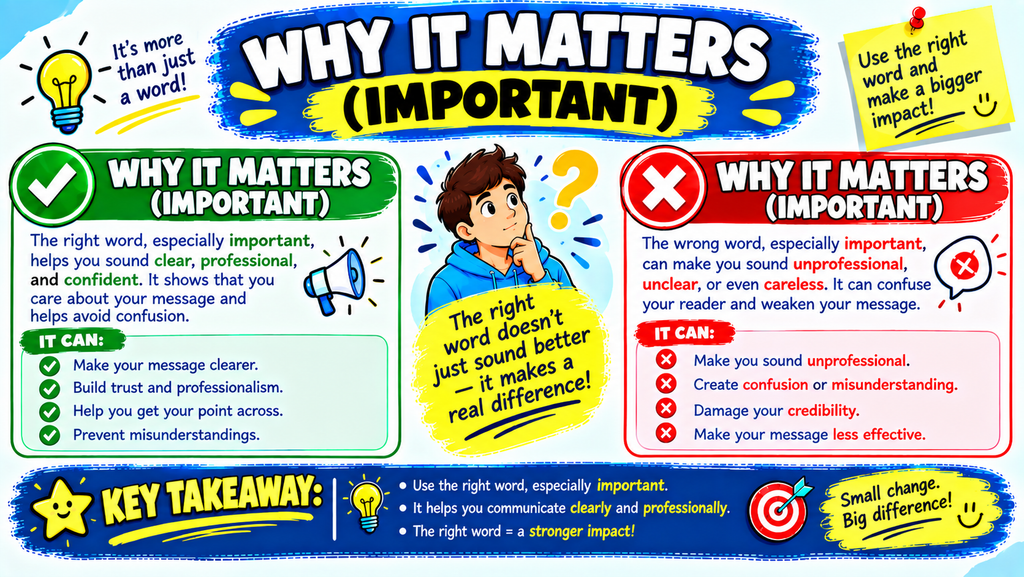
The right phrase shows readers exactly where your priorities sit. 👀 It also keeps your sentences smooth and easy to scan. 🧹
Professionalism
Small grammar slips can weaken a strong message. 🎓 Correct usage signals care in emails, resumes, and proposals. 📧
Writing Accuracy
Grammar rules work like road signs. 🚦 Knowing the adjective-adverb split helps you fix errors before readers spot them. ✅
Digital Communication
On blogs, newsletters, and social posts, people skim fast. ⚡ A well-placed “most importantly” tells them where to look. 🔦
Special Exception
A few cases bend the usual rules. 🌀
- Sentence openers: many editors accept both “Most important,” and “Most importantly,”. 🔄 Some prefer the adjective, so follow your style guide. 📖
- “Of all” phrases: “Most important of all” and “most importantly of all” both appear in everyday writing. 🎬
- Importantly alone: “Importantly, sales grew” works, but “Important, sales grew” does not. ⚖️
- Fixed clauses: “What is most important is…” always uses the adjective. 🔗
Quick Recap Checklist
- ✅ Most important = adjective, used with nouns.
- ✅ Most importantly = adverb, used to stress a point.
- ✅ Add a comma after “Most importantly” at the start of a sentence.
- ✅ Never put “most importantly” before a noun.
- ✅ Keep “the” in “the most important thing.”
- ✅ Check your style guide for sentence-opener preferences.
- ✅ Use it once per piece, not in every paragraph.
Frequently Asked Questions
What is the difference between most important and most importantly?
“Most important” is an adjective that describes a noun. “Most importantly” is an adverb that stresses a key point. 🎯
Is “most importantly” grammatically correct?
Yes. It works as a sentence adverb and appears widely in respected writing. ✅
Can I start a sentence with “most important”?
Yes, many editors accept it as a shortened form of “what is most important.” Some style guides prefer “most importantly,” so check yours. 📖
Is “more importantly” correct?
Yes. It follows the same rule and is used when comparing one point with another. ⚖️
Do I need a comma after “most importantly”?
Yes, when it opens a sentence. The comma sets off the spotlight phrase. ✍️
Can I say “the most importantly thing”?
No. An adverb can’t describe a noun, so say “the most important thing.” ❌
Which one is better for formal writing?
Both work in formal writing. Choose based on sentence structure and your style guide. 🎓
What can I use instead of “most importantly”?
Try “above all,” “first and foremost,” or “above everything else.” 🔄
Conclusion
The difference between most important and most importantly comes down to one simple split. 🧩 Use “most important” to describe a thing, and use “most importantly” to spotlight a point. 🔦 At the start of a sentence, both are widely accepted, so let tone and your style guide decide. 📖 Keep the comma rule in mind, avoid the “importantly” before a noun trap, and your writing will read clean and confident. 🚀
