

If you’ve ever paused mid-sentence wondering whether to write “oftentimes” or “often times,” you’re not alone. 🤔 This is one of the most common word-spacing mix-ups in English, and getting it wrong can make your writing look less polished than it is.
Here’s the short version: only one of these is the standard, dictionary-recognized word. Let’s break down exactly which one, why, and how to use it with confidence.
Quick Answer: Oftentimes vs Often Times
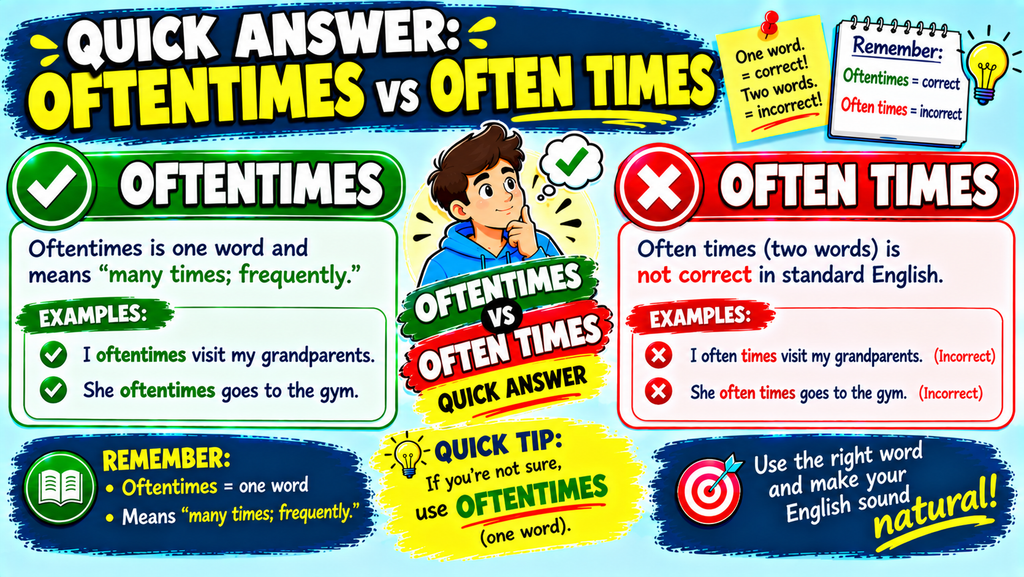
Oftentimes (one word) is the correct, standard spelling. It’s a legitimate adverb meaning “frequently” or “many times,” and you’ll find it in Merriam-Webster and other major dictionaries. 📖
Often times (two words) is considered a nonstandard variant. It shows up in casual writing and speech, but most style guides and editors flag it as an error or, at best, an outdated spelling choice.
| Header label | Oftentimes | Often Times |
|---|---|---|
| Standard spelling? | ✅ Yes | ❌ No |
| Found in dictionaries? | Yes | Rarely, and usually as a variant note |
| Recommended for formal writing? | Yes | No |
| Common usage region | Mostly North America | Informal speech, casual text |
Understanding the Basics: Oftentimes vs Often Times
Both words trace back to the same root idea, but only one survived the editing process of modern English. 🖊️
“Oftentimes” has existed since the 14th century, originally written as “oft-times” or “often-tide,” back when “tide” was still used to mean “time” (think “Yuletide”). Over the centuries, English speakers fused the two words together, and “oftentimes” became the accepted single-word form.
“Often times,” on the other hand, is essentially a spaced-out spelling of that same word. It didn’t become its own accepted term — it’s more of a lingering habit than a legitimate variant.
Comparison Table: Side-by-Side Breakdown
| Feature | Oftentimes | Often Times |
|---|---|---|
| Part of speech | Adverb | Not standard |
| Meaning | Frequently, on many occasions | Same intended meaning, incorrect form |
| Word count | One word | Two words (incorrect split) |
| Formality | Formal, slightly literary | Informal, often seen as a typo |
| Best used in | Essays, articles, professional writing | Avoid in most writing |
Correct Meanings & Uses
What Does “Oftentimes” Mean?
“Oftentimes” means the same thing as “often” — frequently, repeatedly, or on many occasions. It functions as an adverb and typically sits before the main verb or right after a form of “to be.” ⏰
It carries a slightly more formal, almost literary tone compared to plain “often,” which is why you’ll see it more in essays, articles, and narrative writing than in casual chat.
Example Breakdown
Take this sentence: “Oftentimes, small businesses struggle with cash flow in their first year.”
Here, “oftentimes” sits at the start of the sentence and modifies the entire statement, signaling that this situation happens frequently. You could swap in “often” without losing meaning proof that they’re functionally interchangeable. 🔄
More Examples
- Oftentimes, the simplest solution is the best one.
- She oftentimes finishes her reports ahead of schedule.
- Oftentimes, customer feedback reveals problems the team never noticed.
- Job seekers oftentimes underestimate the importance of a strong résumé.
Why “Often Times” Is Incorrect
The split version breaks a rule that’s been settled for roughly 500 years: since the 1500s, “oftentimes” has been written as a single, closed compound word. Splitting it into two words isn’t an alternate spelling — it’s simply a mistake that happens because “often” and “times” are both common, everyday words that people instinctively want to separate. ❌
Test Tip
Here’s a quick trick: if you can replace the word with “often” and the sentence still makes sense, it should be written as one word “oftentimes” never two. 💡
Case Study: Real Usage in Context
Grammar rules matter most when they show up in real communication — and this one shows up more often than you’d think.
Real-Life Example: Workplace Email
Before: “Often times, our team misses deadlines because of unclear priorities.”
After: “Oftentimes, our team misses deadlines because of unclear priorities.”
The fix is a single keystroke, but it changes how the email reads. The corrected version looks intentional and professional; the original version reads like a typo that slipped past proofreading.
Why It Matters: In business writing, small errors like this can quietly undercut your credibility, even when your ideas are solid. Readers notice polish, even subconsciously. ✍️
Grammar Rules Explanation
English has a small category of words formed by fusing “oft” (an old word for “often”) with another term: oftentimes, ofttimes, and oft-repeated are the main survivors. Once a compound like this becomes standardized, splitting it back into separate words is treated as an error, not a stylistic choice.
Key Rule:
Compound adverbs formed with “oft” or “often” — like oftentimes — are always written as one word in standard English. There is no accepted two-word version. 📌
Common Mistakes Section
Why Do People Get It Wrong?
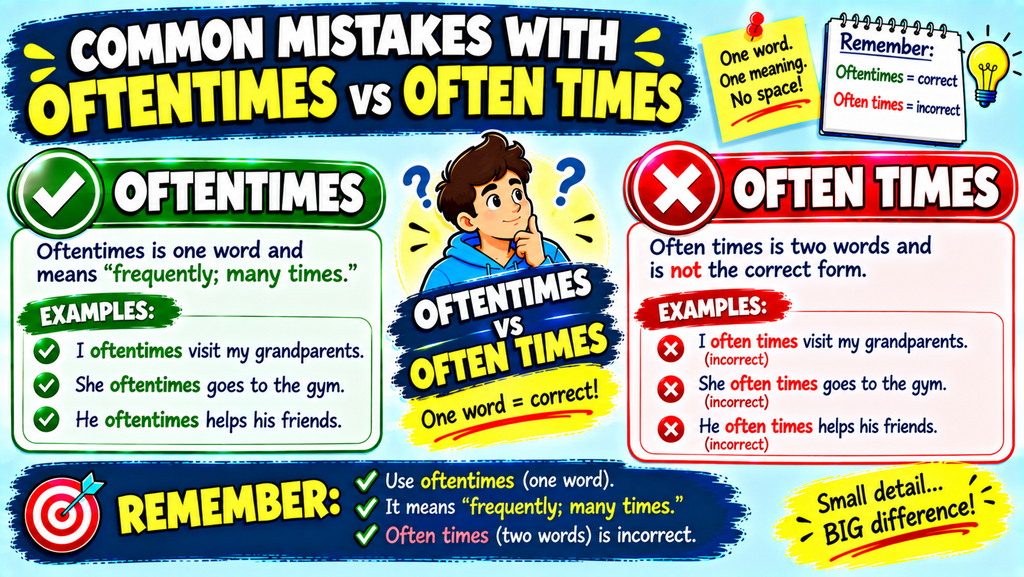
- Auto-correct assumptions — some writers assume two familiar words should stay separate.
- Regional habits — informal speech patterns bleed into writing.
- Visual logic — “often” and “times” look like they should function as two separate words, similar to “many times” or “several times.”
- Lack of exposure — many readers simply haven’t seen the correct spelling often enough to memorize it.
Similar Grammar Confusions Table
This mix-up isn’t unique — English has several look-alike pairs that trip people up the same way. 🧩
| Pair | Correct Form | Notes |
|---|---|---|
| Oftentimes / Often times | Oftentimes | One word, standard |
| Sometime / Some time | Both correct, different meanings | “Sometime” = an unspecified point; “some time” = a duration |
| Everyday / Every day | Both correct, different meanings | “Everyday” = adjective (ordinary); “every day” = adverb phrase |
| Anytime / Any time | Both accepted, “anytime” is more casual | “Any time” is safer in formal writing |
| Awhile / A while | Both correct, different roles | “Awhile” is an adverb; “a while” is a noun phrase |
Usage in Different Contexts
1. Everyday Conversation
Most people default to “often” in spoken English since it’s shorter and more natural-sounding. “Oftentimes” can feel slightly formal when spoken aloud.
2. Professional Writing
“Oftentimes” works well in reports, emails, and articles when you want a touch more formality than plain “often” — as long as it’s spelled correctly. 💼
3. Creative Writing
Because of its literary history, “oftentimes” adds an old-fashioned or reflective tone, which is why it appears often in fiction, poetry, and narrative essays.
4. Social Media / Texting
Neither version is common here “often” wins for brevity. If “oftentimes” does appear, “often times” almost never should.
Why It Matters (Important Section)
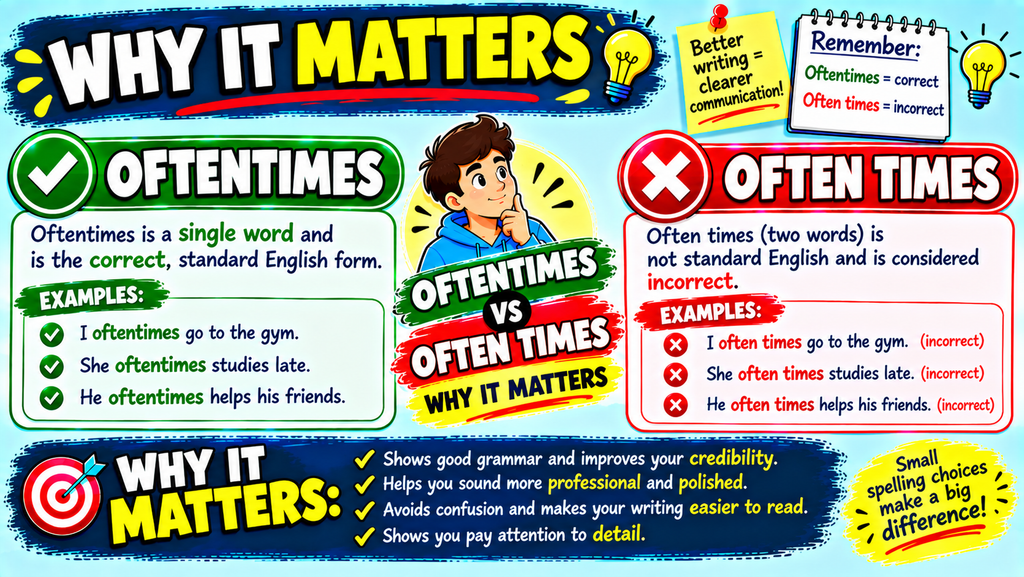
Getting small grammar details right isn’t about being a purist — it’s about clarity and trust. 🎯 Readers, clients, and search engines alike associate clean, correctly spelled writing with credibility. In content marketing especially, consistent grammar accuracy also supports better readability scores, which search engines factor into ranking quality content higher.
Special Exception Section
Here’s where it gets interesting: not every frequency phrase gets fused into one word. “Many times,” “several times,” and “a few times” are always written as two (or more) separate words — there’s no “manytimes” or “severaltimes.” Only a small, historic set of words built from “oft” like oftentimes and ofttimes — became single-word compounds. This makes “oftentimes” the exception, not the rule. ⚠️
Quick Recap Checklist
- ✅ Use oftentimes as one word — always.
- ❌ Never write often times as two words.
- ✅ “Oftentimes” and “often” are interchangeable in meaning.
- ✅ “Oftentimes” suits formal or literary writing; “often” suits everyday speech.
- ❌ Don’t apply the “one-word” rule to phrases like “many times” or “several times.”
Practice Examples
Try fixing these sentences yourself:
- “Often times, deadlines shift without warning.” → Oftentimes, deadlines shift without warning.
- “He often times skips breakfast.” → He oftentimes skips breakfast.
- “Often times, the smallest details make the biggest difference.” → Oftentimes, the smallest details make the biggest difference.
Frequently asked questions
Is “oftentimes” a real word?
Yes. It’s a standard adverb listed in major dictionaries, meaning “often” or “frequently.” ✅
Is “oftentimes” formal or informal?
It leans formal to neutral, with a slightly literary tone compared to plain “often.”
Can I use “oftentimes” in academic writing?
Yes, it’s acceptable in academic and professional writing, though “often” is usually simpler and just as effective.
Is “oftentimes” British or American English?
It’s used mainly in American and Canadian English; it’s rare and considered old-fashioned in British English.
What can I use instead of “oftentimes”?
“Often,” “frequently,” “regularly,” and “commonly” all work as simpler alternatives.
Is “often times” ever correct?
No it’s considered a spelling error, not an accepted variant. Always use “oftentimes” as one word.
Conclusion
The rule here is refreshingly simple once you know it: oftentimes is one word, always, and often times isn’t a real alternative — it’s just a common typo. 🎉 Whether you’re writing a business email, a blog post, or a school essay, sticking with “oftentimes” (or the even simpler “often”) keeps your writing clean, correct, and credible.
