

If you’ve ever paused mid-sentence wondering whether to write “passerbyers” or “passersby,” you’re not alone. 📝 This is one of the most commonly mistyped plural nouns in English, and search volume for it climbs every year as more people write online. In this guide, you’ll get a clear, no-nonsense answer, backed by grammar rules, real examples, and a few memory tricks you’ll actually remember.
Quick Answer: Passerbyers vs Passersby ✅
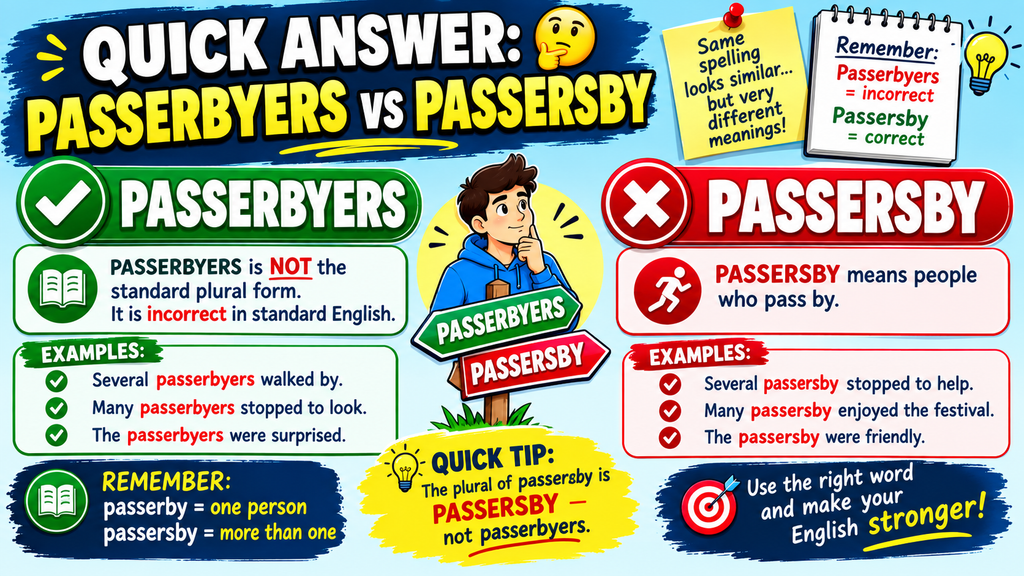
“Passersby” is correct. “Passerbyers” is not a real word and should never be used.
- ✅ Correct singular: passerby (one person walking past)
- ✅ Correct plural: passersby (more than one person walking past)
- ❌ Incorrect: passerbyers — this form doesn’t exist in any English dictionary
- ❌ Also incorrect (common typo): passerbys
If you remember nothing else from this article, remember this rule. 🔑
Understanding the Basics: Passerbyers vs Passersby
English usually forms plurals by adding “-s” or “-es” to the end of a word (car → cars, box → boxes). But “passerby” isn’t a simple noun — it’s a compact compound made of “passer” + “by.” That structure is exactly why the plural doesn’t follow the pattern most people expect.
Key Rule
- The word “passerby” is built from an agent noun (“passer”) plus a preposition (“by”). 📚
- When you pluralize it, the “-s” attaches to the noun part (“passer”), not to the end of the whole word.
- That gives you passers + by = passersby, not “passerbys” and definitely not “passerbyers.”
Comparison Table
| Word | Is It Correct? | Why |
|---|---|---|
| Passerby | ✅ Yes (singular) | Standard dictionary spelling |
| Passersby | ✅ Yes (plural) | Plural marker goes on “passer,” the noun element |
| Passerbys | ❌ No | Treats the whole compound as one simple noun |
| Passerbyers | ❌ No | Adds an extra, nonexistent “-er” agent suffix to an already complete word |
| Passer-by / Passers-by | ✅ Yes (older style) | Hyphenated variant still listed in some dictionaries |
Correct Meanings & Uses
What Does “Passerby” Mean?
A passerby is a single person who happens to be walking past a place or event, usually without being directly involved in it. 🚶 Think of someone who just happens to be on the sidewalk when something newsworthy happens.
Example: A passerby noticed smoke coming from the second-floor window and called the fire department.
What Does “Passersby” Mean?
Passersby is simply the plural — more than one person walking past. It’s the form you’ll see most often in news reports, since incidents rarely involve just one bystander.
Examples:
- Several passersby stopped to help after the cyclist fell. 🚴
- The street performer drew a small crowd of curious passersby.
- Passersby were the first to alert police about the accident.
Test Tip 💡
Here’s a simple trick: mentally split the word into “passers” + “by.” If “passers” sounds right as a plural on its own (it does — passer, passers), then “passersby” is right too. There’s no version of English where you’d say “passerers” or “byers,” so there’s no version where “passerbyers” makes sense either. ✅
Case Study Section
Real-Life Example: Workplace Email
Imagine an office manager drafting an incident report after a minor accident in the parking lot.
Before (incorrect): “Two passerbyers saw the fender bender and gave statements to security.”
After (correct): “Two passersby saw the fender bender and gave statements to security.”
The correction is small, but it changes how the document reads to anyone reviewing it later. 📄
Why This Matters
Grammar mistakes like “passerbyers” can quietly undermine credibility in professional writing — resumes, incident reports, legal statements, and client emails included. A single wrong word won’t ruin your message, but consistent small errors add up and can make careful readers question your attention to detail.
Grammar Rules Explanation
Structure of “Passerby”
“Passerby” is a compound noun: “passer” (someone who passes) + “by” (a directional preposition meaning “alongside” or “past”). Unlike compounds such as “toothbrush” or “sunflower,” this one doesn’t behave like a single unbroken unit when pluralized.
Plural Formation
English has a small family of compound nouns that pluralize their first element instead of their last one. This is often called internal pluralization. Passersby belongs to this family, alongside:
- mother-in-law → mothers-in-law
- attorney general → attorneys general
- runner-up → runners-up
- editor-in-chief → editors-in-chief
In every case, the plural marker lands on the noun that’s actually doing the “counting,” not on whatever word happens to sit at the end.
Why “Passerbyers” Is Wrong
“Passerbyers” tries to add an agent-forming “-er” suffix (like in “worker” or “teacher”) onto a word that already ends in a preposition, then tack a plural “-s” on top. That’s a double mistake: “by” isn’t a verb root that can take “-er,” and the word already has its plural built in through “passers.” There’s no rule in English grammar that supports this construction. ❌
Common Mistakes Section
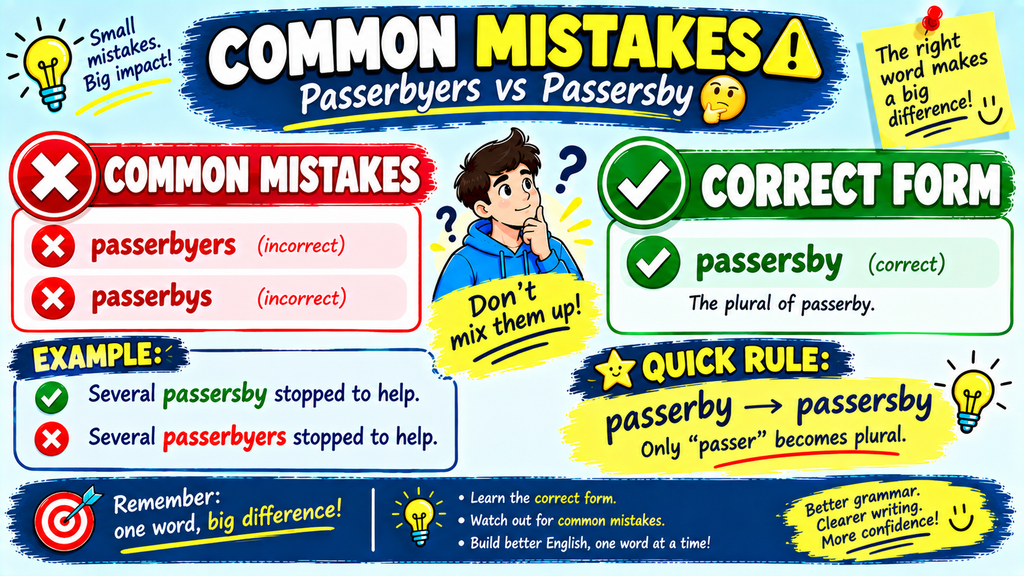
Why Do People Say “Passerbyers”?
This error usually comes from three habits:
- Overgeneralizing the “-er” pattern — English uses “-er” constantly to describe people who do things (runner, walker, worker), so it feels natural to tack it onto “passerby” too.
- Mishearing “passersby” — spoken quickly, “passersby” can sound like it has an extra syllable, leading to a guessed spelling.
- Simple unfamiliarity — because “passerby” is used far less often than everyday nouns, many writers have never actually seen the correct plural in print.
Similar Grammar Confusions
- Attorney generals vs. attorneys general
- Court martials vs. courts martial
- Spoonfuls vs. spoonsful (both are technically accepted, but “spoonfuls” is now more common)
- Mother-in-laws vs. mothers-in-law
If you’ve ever hesitated on any of these, the same internal-pluralization logic applies. 🧠
Usage in Different Contexts
1. Everyday Conversation
Casual speech is forgiving, but “passersby” still sounds more natural than any alternative: “A few passersby helped push the stalled car.”
2. Professional Writing
In reports, journalism, and legal documents, “passersby” is the expected, standard form. Editors and proofreaders will flag “passerbys” or “passerbyers” every time. 📰
3. Creative Writing
Fiction writers often use “passersby” to set a scene quickly: “The passersby barely glanced at the street performer, hurrying home before the rain started.”
4. Social Media / Texting
Even in short-form writing, “passersby” doesn’t need shortening. Autocorrect on most phones will already suggest it, so there’s little excuse for the error even when typing fast. 📱
Why It Matters (Important Section)
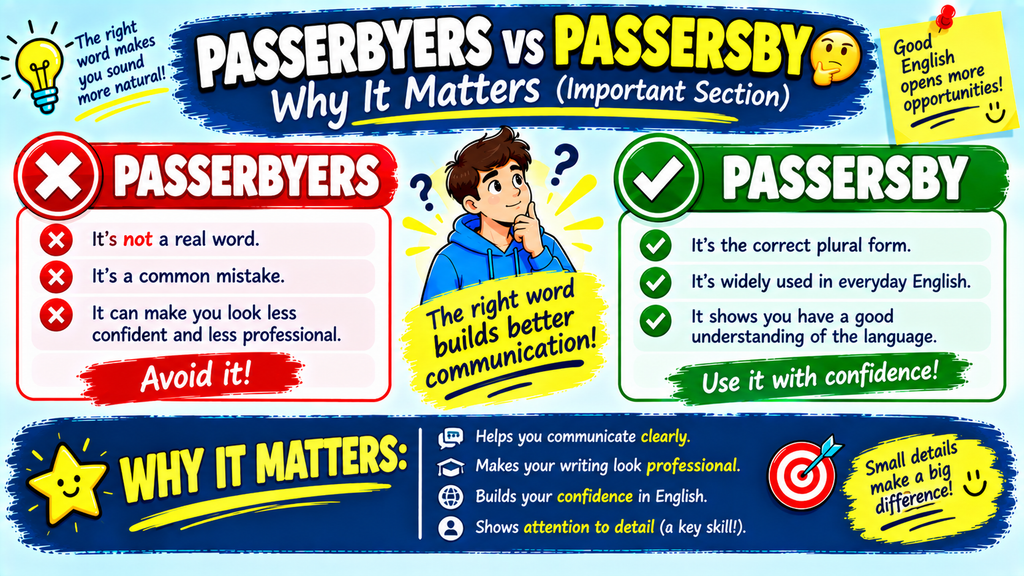
Getting this word right isn’t just about pedantry — it reflects broader writing habits that readers, editors, and search engines all notice.
Key Benefits
- Credibility: Correct grammar builds trust with readers and clients. ✅
- Clarity: “Passersby” is instantly recognizable; invented forms slow readers down.
- SEO value: Search engines reward content that uses standard, dictionary-accurate language.
- Professionalism: Clean copy signals care, especially in reports, journalism, and business writing.
Special Exception Section
There is one accepted variant worth knowing: the older hyphenated spelling passer-by (singular) and passers-by (plural). Some dictionaries still list this style as valid, particularly in British English and older texts. What’s not accepted anywhere, in any style guide or dictionary, is “passerbyers” or “passerbys” — both are considered clear errors, even though “passerbys” shows up occasionally in casual online writing. 🚫
Quick Recap Checklist ✅
- One person? Use passerby.
- More than one? Use passersby.
- Never use passerbyers — it isn’t a word.
- Avoid passerbys in formal or professional writing.
- The old hyphenated style (passer-by / passers-by) is still acceptable if you prefer it.
Decision Table
| If you mean… | Use this word |
|---|---|
| One person walking past | Passerby |
| Two or more people walking past | Passersby |
| A formal/older style, singular | Passer-by |
| A formal/older style, plural | Passers-by |
Practice Examples
Try filling in the blank before checking the answer:
- A ______ called for help after witnessing the collision. → passerby
- Dozens of ______ gathered to watch the street parade. → passersby
- The reporter interviewed three ______ near the scene. → passersby
- Not a single ______ noticed the open manhole. → passerby
Frequently Asked Questions
Is “passerbyers” a real word?
No. It doesn’t appear in any English dictionary and is considered a clear spelling error.
What is the plural of “passerby”?
The correct plural is “passersby,” formed by pluralizing “passer,” not “by.”
Is “passerbys” acceptable?
It’s a common mistake, but it’s not standard. Use “passersby” in formal and professional writing.
Is “passersby” singular or plural?
“Passersby” is always plural; “passerby” is the singular form.
How do you pronounce “passersby”?
It’s pronounced puh-sərz-BY, with the stress on the final syllable.
What’s a synonym for “passerby”?
Common alternatives include bystander, onlooker, pedestrian, and witness, depending on context.
Is “passerby” one word or hyphenated?
Modern dictionaries list it as one word (“passerby”), though the older hyphenated form (“passer-by”) is still recognized.
Conclusion
The confusion between “passerbyers” and “passersby” comes down to one simple grammar quirk: English sometimes pluralizes the middle of a compound word instead of the end. Once you know that “passerby” splits into “passer” + “by,” the correct plural — passersby — stops feeling like an exception and starts feeling like common sense. Keep this guide handy the next time you’re drafting a report, an email, or a story, and you’ll never second-guess this word again. ✅
