

If you’ve ever paused mid-sentence wondering whether to write “please respond” or “please response,” you’re not alone. 📝 These two words look almost identical and share the same root, but they play completely different grammatical roles. Getting them mixed up is one of the most common English errors even among fluent speakers and professional writers.
This guide breaks down exactly when to use respond and when to use response, with real examples, a case study, common mistakes, and a quick practice section so the difference finally sticks.
Quick Answer: Respond vs Response
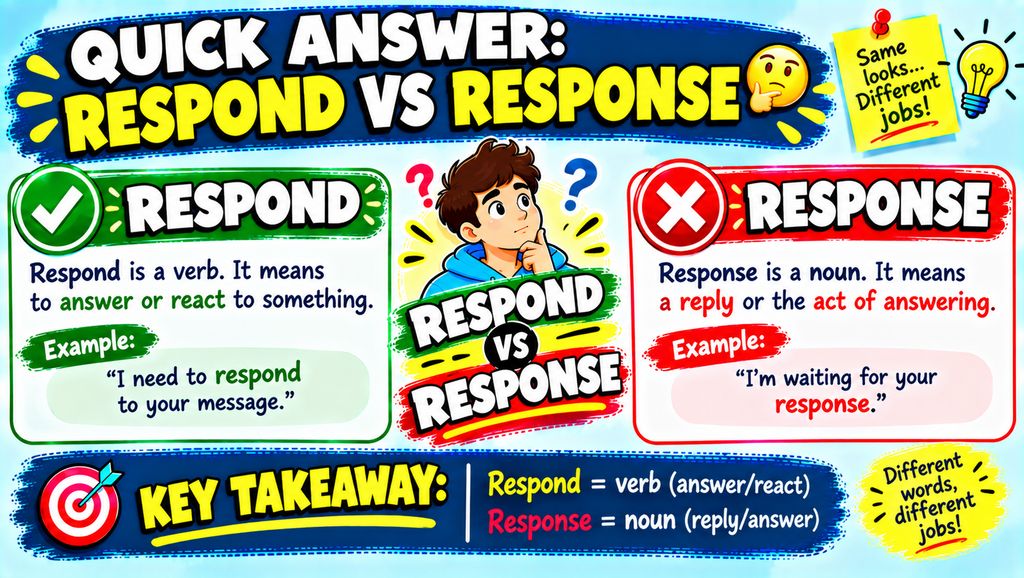
Here’s the short version before we go deeper. ⚡
| Word | Part of Speech | Meaning | Example |
|---|---|---|---|
| Respond | Verb | To reply, answer, or react to something | “Please respond to my email by Friday.” |
| Response | Noun | The reply, answer, or reaction itself | “I haven’t received your response yet.” |
The simplest way to remember it: respond is the action, response is the thing produced by that action. 🎯
Understanding the Basics of Respond vs Response
English has thousands of verb-noun pairs like this decide/decision, react/reaction, describe/description. Respond and response follow the same pattern.
- Respond describes what someone does.
- Response describes what someone gives or produces as a result.
Once you internalize that one distinction, almost every sentence involving these words becomes easy to get right. ✅
Correct Meanings & Uses
1. What Does “Respond” Mean?
Respond is a verb meaning to answer, reply, or react to a question, situation, or stimulus. It’s commonly followed by the preposition “to.” 🗣️
Examples:
- She will respond to the customer’s complaint today.
- He didn’t respond when I called his name.
- Plants respond to sunlight by growing toward it.
- The manager responded quickly to the crisis.
Sentence Breakdown:
In “She will respond to the customer’s complaint,” respond is the main verb, “will” marks future tense, and “to the customer’s complaint” is the prepositional phrase showing what she’s reacting to. Notice that respond almost never takes a direct object without “to” you don’t “respond an email,” you “respond to an email.” ⚠️
2. What Does “Response” Mean?
Response is a noun referring to the actual reply, answer, or reaction the outcome of responding. It’s the thing you can point to, quote, or measure. 📩
Examples:
- I received a thoughtful response from the HR team.
- Her response surprised everyone in the meeting.
- The survey generated hundreds of responses overnight.
- His immune response fought off the infection quickly.
Sentence Breakdown:
In “I received a thoughtful response from the HR team,” response functions as the object of the sentence it’s a “thing” being received, modified by the adjective “thoughtful.” As a noun, it can take articles (a, the) and adjectives, something a verb like respond can never do. 🧩
Case Study: Real-Life Usage
Workplace Email Example
Imagine two coworkers drafting the same message:
- ❌ “Please response as soon as possible.” (Incorrect — response is a noun, not a verb.)
- ✅ “Please respond as soon as possible.” (Correct — an action is being requested.)
- ✅ “I’m still waiting on your response.” (Correct — referring to the reply itself.)
Real-Life Scenario
A customer support agent writes: “Thank you for reaching out. I will respond within 24 hours, and you’ll receive a full response outlining next steps.” This single sentence shows both words working correctly side by side one as the promised action, one as the resulting document. 💼
Grammar Rules Explanation
Key Grammar Rule:
- Respond = verb → conjugates with tense (respond, responds, responded, responding).
- Response = noun → pluralizes normally (response, responses) and pairs with articles/adjectives.
- Respond is typically intransitive and pairs with “to” (respond to something).
- Response often appears in the phrase “in response to,” which itself functions like a connector between ideas.
Common Mistakes
Here are the errors people make most often: 🚫
- “Please response to this message.” → Should be respond.
- “I need a respond from you.” → Should be response.
- “He didn’t response.” → Should be respond.
- “In response of your request” → Should be in response to.
- “Respond back to me” → Redundant; just say “respond to me.”
Why Do People Confuse Respond vs Response?
Both words come from the same Latin root, respondere, meaning “to promise in return.” Because they share nearly identical spelling and pronunciation, the brain often autocorrects one for the other, especially when typing quickly. 🧠 Non-native English speakers are especially prone to this mix-up because many languages don’t distinguish verb and noun forms with a suffix change the way English does. Autocorrect tools and voice-to-text software can also introduce the wrong form without the writer noticing.
Common Grammar Confusions Table
Respond/response isn’t the only pair that trips people up. Here are similar word confusions worth knowing: 📊
| Word Pair | Quick Tip |
|---|---|
| Respond / Response | Respond = verb, Response = noun |
| Advice / Advise | Advice = noun, Advise = verb |
| Affect / Effect | Affect = verb (usually), Effect = noun (usually) |
| Accept / Except | Accept = to receive, Except = to exclude |
| Then / Than | Then = time, Than = comparison |
| Complement / Compliment | Complement = completes, Compliment = praise |
Usage in Different Contexts
1. Everyday Conversation
In casual speech, people often say things like “I never got a response” or “Can you respond when you get a chance?” — both natural and correct. 💬
2. Professional Writing
Business emails frequently use both forms: “Kindly respond at your earliest convenience” or “Your prompt response is appreciated.” Formal tone favors precise, error-free usage here since mistakes can look unprofessional. 📧
3. Creative Writing ✍️
Novelists and poets use response to describe emotional reactions (“a quiet response to grief”) and respond to show characters acting in real time (“she responded with a smile”). Both add texture to dialogue and narration.
4. Social Media/Texting
Shortened, informal usage is common: “no response yet 😩” or “gonna respond later.” Even in casual digital spaces, keeping the verb/noun distinction correct helps messages read smoothly. 📱
Why It Matters
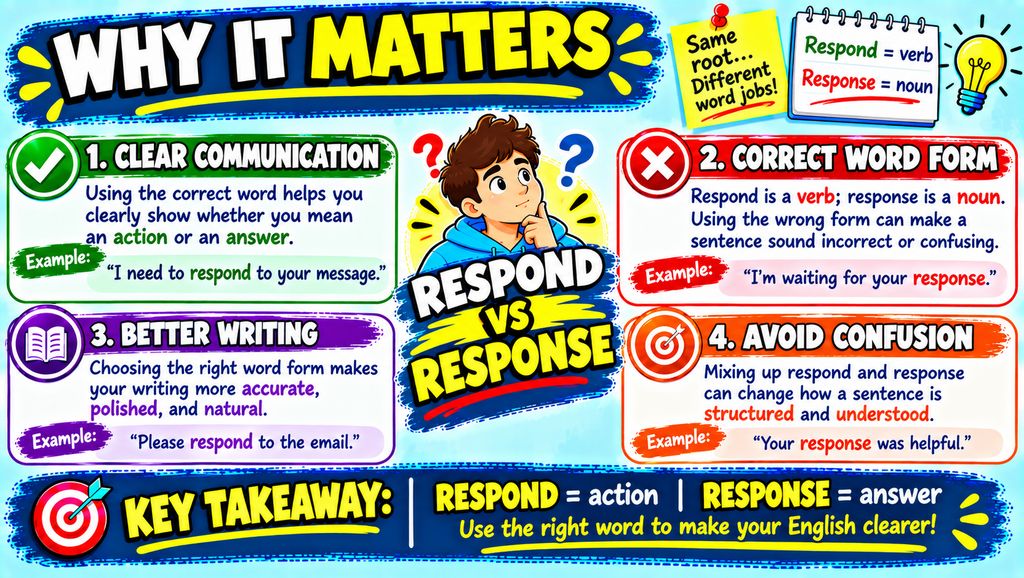
Mixing up respond and response might seem minor, but it affects clarity, professionalism, and credibility — especially in emails, resumes, academic writing, and customer communication. ✅ It’s also a frequent point tested in English proficiency exams like IELTS and TOEFL, and a common flag in grammar-checking tools and content editing for SEO writing.
Special Exception
There’s one notable exception to the “respond always needs to” rule: when respond introduces a direct quotation, no preposition is needed. For example: “I’m not sure,” she responded. Here, responded connects directly to spoken words rather than to an object introduced by “to.” ⚡
Quick Recap Checklist
- ✅ Use respond as a verb describing an action.
- ✅ Use response as a noun describing the result of that action.
- ✅ Pair respond with “to” (except before a direct quote).
- ✅ Give response an article or adjective when needed (a response, quick response).
- ✅ Double-check autocorrect before hitting send. 📩
Practice Examples
Fill in the blank with respond or response:
- She hasn’t ______ to my text yet. (respond)
- His ______ to the news was calm and measured. (response)
- Please ______ within 48 hours. (respond)
- The company issued an official ______ to the complaint. (response)
- Plants ______ to changes in light and temperature. (respond)
Frequently asked questions: Respond vs Response
Is “response” a verb?
No, response is always a noun. The verb form is respond.
What is the past tense of respond?
The past tense is responded (e.g., “She responded immediately”).
Can response ever function as a verb?
No English has no verb form of “response”; respond is the only verb version.
What’s the difference between respond and reply?
They’re close synonyms, but respond is slightly more formal and versatile, while reply is more common in everyday speech.
Is “no response” or “no respond” correct?
“No response” is correct, since response is the noun form needed after “no.”
How do you use “response” in a sentence?
Use it as a noun referring to an answer or reaction, such as “Her response was thoughtful and clear.”
Why do people say “respond back”?
It’s a common redundancy “respond” already implies replying, so “back” is unnecessary.
Conclusion
The difference between respond and response comes down to one simple rule: respond is what you do, response is what you produce. 🎯 Once that distinction clicks, you’ll stop second-guessing yourself in emails, essays, and everyday conversations. Keep this guide handy, run through the practice examples occasionally, and correct usage will soon become second nature.✨
