

Ever typed I have ran to the store and paused, wondering if that’s actually correct? 🤔 You’re not alone — run vs ran is one of the most common mix-ups in English, mostly because “run” pulls double duty as both the present tense and the past participle. Confusing the two isn’t just a typo; it’s one of those small slips that can make otherwise polished writing look careless. This guide breaks down exactly when to use each form, why the mix-up happens in the first place, and how to get it right every time — with examples you’ll actually remember. 📚
Quick Answer: Run or Ran ⚡
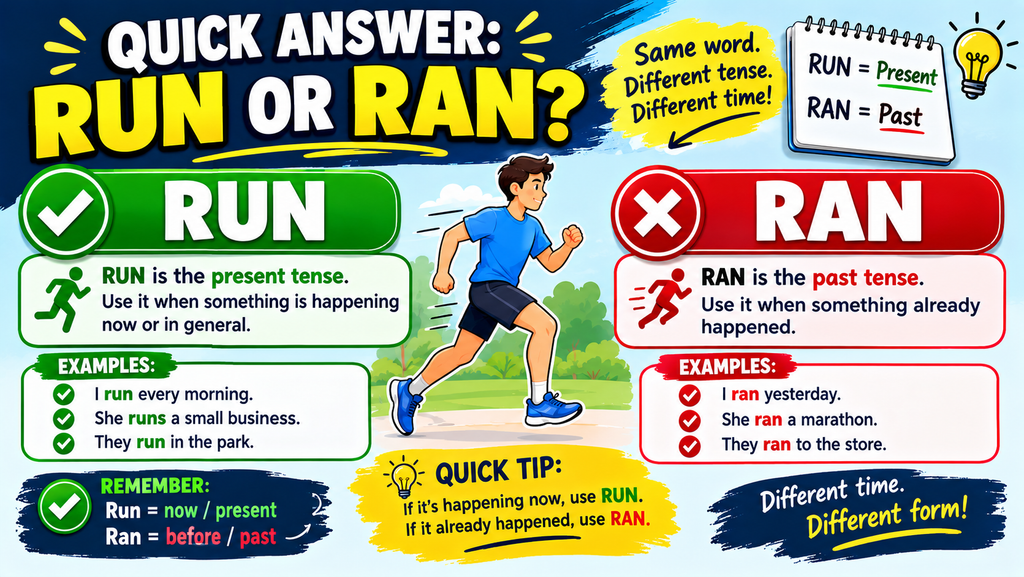
Here’s the short version:
- Run = present tense (I run, you run, we run) or the base form of the verb.
- Ran = simple past tense (I ran, she ran, they ran), used for a completed action.
- Run also doubles as the past participle, paired with has, have, or had — as in “I have run,” not “I have ran.” ✅
| Word | Tense | Example |
|---|---|---|
| Run | Present / base form | I run every morning. |
| Ran | Simple past | I ran five miles yesterday. |
| Run | Past participle | I have run this route before. |
Understanding the Basics of Run or Ran 🧩
“Run” is an irregular verb, meaning it skips the standard “add -ed” pattern that regular verbs follow. Instead, it shifts across three forms:
run → ran → run
Key Idea 💡
Unlike most irregular verbs (think go → went → gone), “run” reuses the exact same spelling for its base form and its past participle. That overlap is the real reason this mix-up exists — your brain sees “run” twice and assumes it’s always safe to use. It isn’t. 🚫
Correct Meanings & Uses
Using “Run” (Present Tense) 🏃
Reach for run when you’re describing:
- Something happening now or habitually: She runs three times a week.
- General facts or instructions: Water runs downhill.
- Future plans with “will”: I will run the marathon next year.
Using “Ran” (Past Tense) 🕰️
Use ran when the action already happened and stands on its own:
- He ran to catch the bus this morning.
- They ran a successful campaign last year.
- The engine ran smoothly until it overheated.
Special Note: Past Participle (Often Confused) ⚠️
This is where most people slip. Whenever a sentence uses has, have, or had — or builds the passive voice with is, was, or been — the correct form is always run, never “ran.”
- ❌ I have ran out of time. → ✅ I have run out of time.
- ❌ The event was ran successfully. → ✅ The event was run successfully.
💬 Quick mnemonic: if it needs a helper verb (have/has/had/was/been), it needs run. If it’s finished and standing completely alone, it’s ran.
(The same rule carries into the future perfect too: I will have run the numbers by Friday.)
Case Study: Real-Life Usage 📂
Workplace Email Example 💼
- ❌ “I have ran the report and sent it to the team.”
- ✅ “I have run the report and sent it to the team.”
Why it matters: a slip like this can quietly undercut how polished your writing looks to a manager or client, even when your meaning is perfectly clear. 📩
Conversation Example 💬
A: “Did you run today?” B: “Yeah, I ran six miles this morning — my legs are done. 😅”
Notice how naturally both forms show up in one short exchange: a question in present tense, an answer in past tense.
Grammar Rules Explanation 📖
Break it down into three quick questions:
- Is the action happening now, or generally true? → run
- Is the action already finished, standing alone in the sentence? → ran
- Is there a helper verb (have/has/had/was/been) or “to” right in front of it? → run
Why This Matters
Many learners — and plenty of native speakers — apply the regular past-tense pattern out of habit, which is why you’ll occasionally hear “runned.” It’s an understandable guess, but it isn’t a real word. 🙅
Here’s the pattern at a glance:
| Situation | Correct Form | Example |
|---|---|---|
| Simple present | run / runs | I run, she runs |
| Simple past | ran | I ran |
| With have / has / had | run | I have run |
| Passive voice | run | It was run smoothly |
| With “to” (infinitive) | run | I want to run |
| Present participle | running | I am running |
Common Mistakes with Run or Ran ❌
Why Mistakes Happen
Most errors come from treating “run” like a regular verb, or forgetting that perfect tenses and passive voice both need the past participle rather than the simple past. 🤯
Common Errors
- ❌ “I have ran” → ✅ “I have run”
- ❌ “I’ve ran into problems all week” → ✅ “I’ve run into problems all week”
- ❌ “If I had ran faster, I’d have won” → ✅ “If I had run faster, I’d have won”
- ❌ “The company was ran by three brothers” → ✅ “The company was run by three brothers”
- ❌ “He runned to the door” → ✅ “He ran to the door”
Similar Grammar Confusions
“Run” isn’t alone. Come and become share its exact pattern (base form = past participle), while verbs like go, see, and do change completely in every form:
| Base Form | Simple Past | Past Participle |
|---|---|---|
| run | ran | run |
| come | came | come |
| go | went | gone |
| see | saw | seen |
| do | did | done |
Usage in Different Contexts 🌍
1. Everyday Conversation
Tense-switching is natural here, and nobody bats an eye: “I run every day, but yesterday I ran twice as far.”
2. Professional Writing
Precision counts in emails, reports, and proposals — stick to have/has/had + run (or passive was/is run) to keep things polished. ✍️
3. Creative Writing
Fiction sometimes uses present-tense narration (“She runs through the forest…”) for immediacy, while past tense feels more traditional. Either works — just stay consistent within one piece. 📖
4. Social Media / Texting
Grammar loosens up here, and “RAN” in all caps often shows up for comedic emphasis. Even so, “run” still means present and “ran” still means past, caps or not. 📱
Special Exception Section: Idioms & Phrasal Verbs 🎯
The run–ran–run pattern holds steady even inside phrasal verbs — only the meaning shifts:
- Run into — to meet by chance: I ran into an old friend.
- Run out (of) — to use something up: We ran out of coffee.
- Run by — to propose informally: Let me run this by you.
- Run up — to accumulate: She ran up a huge bill.
Quick Recap Checklist ✅
- ✅ Use run for present actions, habits, and general truths.
- ✅ Use ran for a completed past action standing alone.
- ✅ Always pair have/has/had and passive was/been with run, never “ran.”
- ✅ “Runned” is never correct — “run” is irregular, not regular.
- ✅ Keep your tense consistent across a piece of writing.
Practice Examples ✏️
Fill in each blank with run or ran:
- Yesterday, I ______ five miles before breakfast.
- She has never ______ a marathon before.
- He ______ five miles every single morning.
- They ______ out of gas on the highway last night.
- I need to ______ to the store before it closes.
Answers: 1. ran 2. run 3. runs 4. ran 5. run 🎉
FAQs: Run or Ran 🙋
Is it “I have ran” or “I have run”?
“I have run” is correct — “run” is the past participle and always follows have/has/had.
Is it “was run” or “was ran”?
“Was run” is correct. Passive-voice constructions use the past participle, so “was ran” is never grammatically correct.
Is it “I’ve ran” or “I’ve run”?
“I’ve run” is correct — the contraction “I’ve” still means “I have,” so it needs the past participle “run.”
Is it “if I had ran” or “if I had run”?
“If I had run” is correct. The past perfect (“had + past participle”) always takes “run,” not “ran.”
What is the past tense of “run”?
The simple past tense of “run” is ran.
Why does “run” look identical in two different tenses?
Because it’s irregular — its base form and past participle happen to share the same spelling, unlike verbs such as go/went/gone.
Is “runned” ever correct?
No. “Runned” isn’t a standard word — the correct simple past is always “ran.”
Final Thoughts
The run vs ran debate really comes down to one quick test: if a helper verb like have, has, had, or was sits nearby, reach for run. If the action is finished and standing on its own, ran is your word. 🎯 Bookmark this guide, run through the practice examples one more time, and you’ll never second-guess this pair again. 🚀
