

If you’ve ever paused mid-sentence wondering whether to write “save the file” or “safe the file,” you’re not alone. Save and safe look almost identical, sound similar when spoken quickly, and even share the same Latin root — yet they play completely different grammatical roles. Mixing them up is one of the most common English errors among learners and even native speakers typing in a hurry.
This guide breaks down the meaning, grammar rules, and real-world usage of save vs safe, with examples, a case study, memory tricks, and a quick-reference table so you never second-guess yourself again.
Quick Answer: Save vs Safe
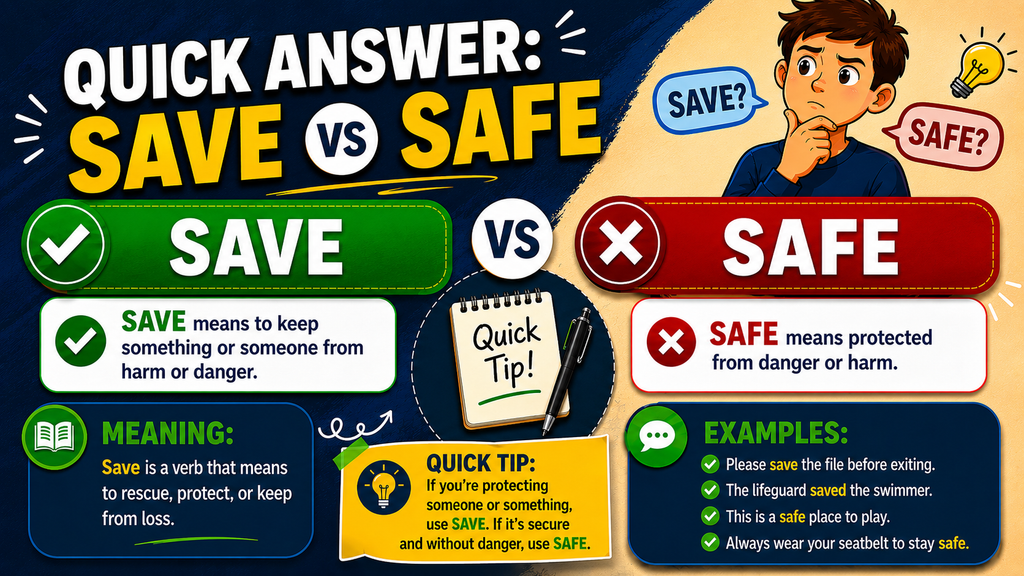
Save is a verb. It means to rescue, protect, store, or set something aside — as in “save a life” or “save your progress.”
Safe is an adjective. It describes a state of being free from danger or harm — as in “the building is safe.”
A simple rule of thumb: save is what you do; safe is how something is.
Understanding the Basics (Save vs Safe)
Both words trace back to the same Latin root, salvus, meaning “uninjured” or “in good health.” That shared history is exactly why they feel so closely related — but over centuries of use, English split them into two distinct jobs.
- Save became an action word (a verb).
- Safe became a describing word (an adjective, and sometimes a noun).
Once you separate the action from the condition, the confusion mostly disappears.
Comparison Table
| Feature | Save | Safe |
|---|---|---|
| Part of speech | Verb (also a noun in sports/computing) | Adjective (also a noun meaning a lockbox) |
| Core meaning | To rescue, protect, store, or preserve | Free from danger, risk, or harm |
| Typical sentence position | Comes before an object (“save the data”) | Comes after a linking verb or before a noun (“is safe,” “a safe place”) |
| Common forms | save, saves, saved, saving | safe, safely (adverb), safety (noun) |
| Example | “She saved the injured bird.” | “The bird is safe now.” |
Correct Meanings and Uses
What Does “Save” Mean?
As a verb, save describes an action someone or something performs. It’s used across everyday speech, technology, finance, and sports.
Common Meanings of Save
- To rescue — to protect someone from harm or danger
- To store — to keep data, files, or documents for later use
- To set aside — to keep money or resources for future use
- To prevent waste — to conserve time, energy, or fuel
- In sports — a “save” is a noun describing a goalkeeper stopping a shot
Examples
- The lifeguard saved the swimmer from drowning.
- Don’t forget to save your document before closing the laptop.
- We’re trying to save money for a house deposit.
- Turning off the lights saves electricity.
Test Tip ✅
If you can swap the word for “rescue,” “store,” or “set aside” and the sentence still makes sense, save is correct.
What Does “Safe” Mean?
As an adjective, safe describes a state or condition — not an action. It tells you that someone or something is protected from harm.
Examples
- The hikers reached the summit and were safe.
- Is it safe to drink this water?
- Keep your passport in the hotel safe.
- She felt safe walking home with a friend.
Test Tip ✅
If you can swap the word for “protected,” “secure,” or “out of danger” and the sentence still makes sense, safe is correct.
Save vs Safe in Sentences
Seeing both words side by side often makes the distinction click faster than any rule.
| Save (action) | Safe (state) |
|---|---|
| He saved his sister from the fire. | His sister is safe after the fire. |
| I save a portion of every paycheck. | My savings are in a safe place. |
| Please save your work regularly. | Your work is safe once it’s backed up. |
| The app saves your location automatically. | Sharing your location isn’t always safe. |
Case Study Section
Workplace Email Example
A single misused word can undercut an otherwise professional message. Here’s a realistic example.
Incorrect Email
Hi Team, Please make sure to safe the quarterly report before 5 PM. We want all files to be save in the shared drive. Thanks, Priya
Correct Email
Hi Team, Please make sure to save the quarterly report before 5 PM. We want all files to be safe in the shared drive. Thanks, Priya
Follow-Up Message
Quick correction to my earlier email — I meant “save” the report and keep the files “safe” on the shared drive. Thanks for your patience!
Practical Lesson
Grammar slips like this are easy to make when typing quickly, but in workplace communication they can look careless. Proofreading for verb-vs-adjective mix-ups takes seconds and instantly boosts credibility.
Grammar Rules Explanation
Why Is “Save” Correct?
“Save” is correct whenever the sentence needs an action. It follows a subject and typically takes a direct object: someone saves something. It also conjugates across tenses — save, saves, saved, saving — which adjectives never do.
Why Is “Safe” Correct?
“Safe” is correct whenever the sentence describes a condition or quality. It usually follows a linking verb (is, was, seems, feels) or sits directly before a noun it modifies, like “a safe environment.”
Simple Grammar Formula
Save
Subject + save/saves/saved + object Example: They saved the documents.
Safe
Subject + linking verb + safe (or safe + noun) Example: The documents are safe. / a safe location
Common Mistakes
Common Errors
Below are three of the most frequent save vs safe mistakes, corrected.
Incorrect
Please safe the file before you shut down the computer.
Correct
Please save the file before you shut down the computer.
Incorrect
The children are save now that the storm has passed.
Correct
The children are safe now that the storm has passed.
Incorrect
I need to safe more money before I travel.
Correct
I need to save more money before I travel.
Similar Grammar Confusions
Save vs safe isn’t the only verb-adjective pair that trips people up. A few related confusions worth knowing:
- Affect vs Effect — affect is usually a verb, effect is usually a noun
- Advice vs Advise — advice is a noun, advise is a verb
- Lose vs Loose — lose is a verb (to misplace), loose is an adjective (not tight)
Usage in Different Contexts
Everyday Conversation
In daily speech, “save” often appears with money, time, or people, while “safe” shows up when reassuring someone about danger or risk.
Conversation Example
A: “Did you save enough for the trip?” B: “Yes, and don’t worry, the hotel area is very safe at night.”
Professional Writing
In business and academic writing, precision matters more, since misused parts of speech can distract readers or weaken credibility in reports, emails, and presentations.
Creative Writing
Fiction writers often lean on “save” for high-stakes action (“he saved her just in time”) and “safe” for emotional or atmospheric description (“the cabin finally felt safe”).
Social Media and Texting
Online, “save” commonly refers to bookmarking a post (“saved this recipe!”), while “safe” is often used informally to mean trustworthy or low-risk, as in calling someone “a safe choice.”
Why It Matters (Important)
1. Clarity in Communication
Using the correct word ensures your listener or reader instantly understands whether you’re describing an action or a condition, avoiding unnecessary re-reading.
2. Professionalism
In resumes, emails, and reports, grammar mistakes like safe/save confusion can make writing look rushed or careless, even when the ideas themselves are solid.
3. Digital Communication Accuracy
Since “save” is a core function word in software (Save As, Auto-Save), misusing it in instructions or documentation can genuinely confuse users.
4. Better Academic Writing
Students who master small grammar distinctions like this tend to score higher on writing assessments, since examiners specifically look for correct part-of-speech usage.
Quote
As many language educators put it: grammar clarity isn’t about sounding fancy — it’s about being understood the first time, without a second read.
Special Exception
Brand Names and Product Names
Some product and feature names deliberately use “safe” as a noun or adjective in branding — like a software “Safe Mode” or a physical “safe” for storing valuables. These are proper nouns or fixed terms, so they don’t follow the usual sentence-level rule and should simply be treated as set phrases rather than grammar to analyze.
Memory Tricks
Trick 1
“Save” has a V, like Verb. If the word is doing something, it needs the V.
Trick 2
Picture a safe (the metal box) — it just sits there, doing nothing, exactly like an adjective describing a state.
Trick 3
Say the sentence out loud and try inserting “is” or “are” before the word. If it sounds natural (“is safe”), use safe. If it sounds odd (“is save”), use save.
Quick Recap Checklist
- Use save when someone or something performs an action (rescue, store, preserve).
- Use safe when describing a state, condition, or quality.
- Save conjugates (saved, saving); safe does not.
- Safe often follows “is/are/was/were”; save often precedes an object.
Decision Table
| Ask yourself… | If yes | If no |
|---|---|---|
| Is the word describing an action? | Use save | Check next question |
| Is the word describing a condition or state? | Use safe | Re-read the sentence for context |
| Can you replace it with “rescue” or “store”? | Use save | Try “protected” or “secure” instead |
Practice Examples
Example 1
“Remember to ______ your essay before the deadline.” → save
Example 2
“The pilot landed the plane and everyone was ______ .” → safe
Example 3
“Firefighters worked all night to ______ the trapped family.” → save
Example 4
“Is it ______ to eat leftovers after five days?” → safe
Frequently asked question Save vs Safe
Is “save” always a verb?
Mostly yes, though it can also be a noun in sports (a goalkeeper’s “save”) or a rare conjunction meaning “except.”
Is “safe” ever a verb?
No. “Safe” is never a verb in standard English; “safeguard” is the closest verb form with a similar meaning.
Can “safe” be a noun?
Yes — a “safe” can refer to a locked metal box used to store valuables.
What’s the adverb form of “safe”?
The adverb form is “safely,” as in “drive safely.”
Which word means “to protect from danger”?
“Save” is the verb used for actively protecting or rescuing someone from danger.
Which word describes being free from danger?
“Safe” is the adjective used to describe a state of being free from danger or risk.
Is it “safe and sound” or “save and sound”?
The correct idiom is “safe and sound,” meaning unharmed and in good condition.
Why do people confuse save and safe so often?
They share a Latin root, similar spelling, and close pronunciation, which makes the distinction easy to overlook while writing quickly.
Conclusion
Save and safe may look like near-twins, but they serve very different roles in a sentence: one is about doing, the other about being. Once you internalize that save is an action and safe is a state, the choice becomes almost automatic. Keep the comparison table and memory tricks from this guide handy, and you’ll never second-guess this pair again — whether you’re writing an email, a report, or a text to a friend.
