

If you’ve ever paused mid-sentence wondering whether to write “snake” or “serpent,” you’re not alone. 🐍 Both words point at the same slithering, legless reptile, yet they carry very different weight depending on where you use them. This guide breaks down the real difference between serpent and snake covering meaning, grammar, symbolism, and everyday usage so you never second-guess the choice again. ✅
Quick Answer: Serpent vs Snake ✅
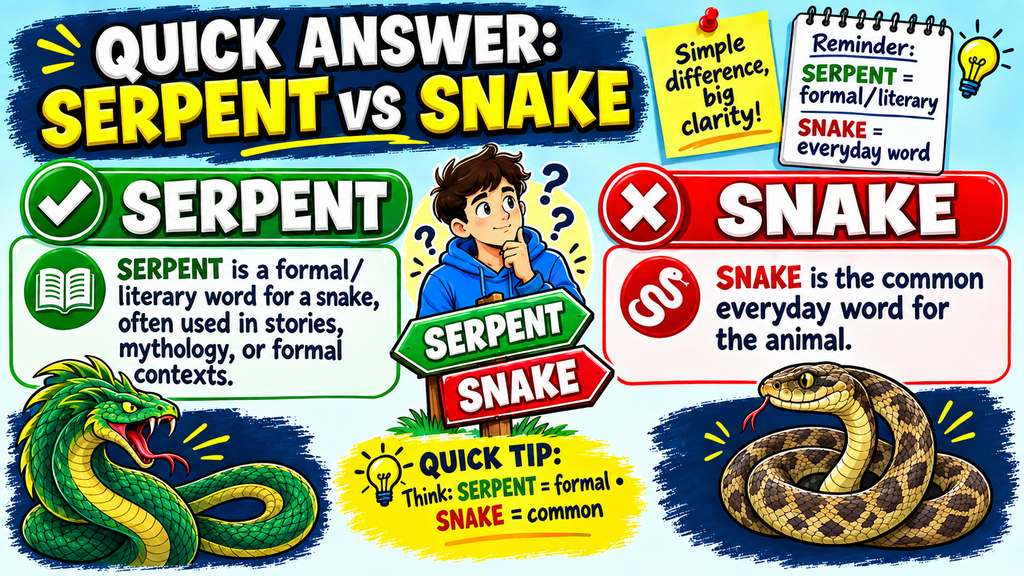
In short: “snake” is the plain, biological word for the reptile you’d spot in your garden or at the zoo. 🐍 “Serpent” is the same animal, dressed up in literary, religious, or mythological language. Every serpent is technically a snake, but not every mention of “serpent” is about a real animal sometimes it’s a symbol, a metaphor, or a legendary creature. 📖
- Snake → scientific, neutral, everyday term
- Serpent → poetic, symbolic, or old-fashioned term
- Both describe the same limbless reptile in the suborder Serpentes
Understanding the Basics: Serpent vs Snake
What Is a Snake?
A snake is a real, living reptile — long-bodied, scaleless-limbed, and found on every continent except Antarctica. 🐍 It’s the term biologists, pet owners, and everyday speakers reach for first.
Key Features of “Snake”:
- Refers to an actual, physical animal 🦎
- Neutral and scientific in tone
- Common in casual conversation and factual writing
- Used as both a noun (“a snake”) and a verb (“the road snakes through the hills”)
Example: A garter snake slid quietly under the porch steps. 🏡
What Is a Serpent?
A serpent is technically the same creature, but the word leans heavily toward myth, religion, and literature rather than biology. 📚 It often signals danger, wisdom, temptation, or something larger-than-life.
Key Features of “Serpent”:
- Carries symbolic or mythological weight ✨
- Common in religious texts, fantasy, and poetry
- Rarely used in casual, everyday speech
- Can also describe a treacherous or deceitful person
Example: In the story, the serpent guarded the sacred treasure for a thousand years. 🐉
Comparison Table: Serpent vs Snake
| Feature | Snake | Serpent |
|---|---|---|
| Definition | Real, legless reptile | Symbolic or mythical version of a snake |
| Word Origin | Old English snaca | Latin serpens (“to creep”) |
| Tone | Neutral, scientific | Poetic, dramatic, old-fashioned |
| Common Context | Biology, everyday speech | Religion, mythology, literature |
| Connotation | Fact-based | Emotional or moral (evil, wisdom, danger) |
| Example Use | “The snake shed its skin.” | “The serpent tempted Eve in Eden.” |
Correct Meanings & Uses
1. “Snake” in Everyday English
Examples:
- The zoo added a new species of tree snake this year. 🐍
- Watch out — there’s a snake near the woodpile!
- Her handwriting seemed to snake across the page.
Sentence Breakdown: In “the zoo added a new species of tree snake,” the word functions purely as a noun naming a real animal — no hidden meaning, just biology. 🔬
2. “Serpent” in Literature and Symbolism
Examples:
- The ancient serpent was said to guard the underworld’s gates. 🔥
- He was called a serpent for betraying his closest friend.
- The serpent motif appears in art across nearly every culture.
Sentence Breakdown: In “he was called a serpent for betraying his closest friend,” the word isn’t about an animal at all — it’s a metaphor for cunning, treachery, or hidden danger. 🎭
Test Tip 💡
If you can swap the word for “reptile” and the sentence still makes sense, use snake. If the sentence is really about danger, evil, or myth, serpent usually fits better.
Case Study Section: Real-Life Usage
Workplace Example
A colleague who quietly undermines coworkers might get called “a serpent in the office” — a metaphor, not a literal accusation. 💼
Literary Example
Classic texts, from religious scripture to epic poetry, favor “serpent” to give a scene weight and symbolism rather than plain description. 📖
Conversation Example
A hiker warning friends on a trail would say, “There’s a snake up ahead” — never “serpent,” because everyday speech favors the simpler word. 🥾
Grammar Rules Explanation
Key Grammar Insight:
- Both “snake” and “serpent” are common nouns and follow standard pluralization rules: snakes, serpents. ✍️
- Neither word is capitalized unless it starts a sentence or is part of a proper noun (e.g., “Serpent King”).
- “Snake” can function as a verb (to snake through something); “serpent” cannot.
Why This Matters: Choosing the wrong word rarely creates a grammar error, but it can send the wrong tone — calling a garden visitor a “serpent” sounds overly dramatic, while calling a biblical figure a “snake” can feel oddly casual. 🎯
Why People Get Confused
Because both words describe the exact same animal biologically, many writers assume they’re fully interchangeable in every context — but tone and audience expectations say otherwise. 🤔
Common Grammar Confusions Table
| Mistake | Why It’s Wrong | Correct Usage |
|---|---|---|
| Using “serpent” in a casual chat | Sounds overly formal or dramatic | Use “snake” instead |
| Using “snake” in a solemn religious passage | Loses intended symbolic tone | Use “serpent” instead |
| Assuming “serpent” refers only to giant creatures | Size isn’t part of the definition | Serpent just means symbolic snake |
| Treating “serpent” as a scientific term | It has no biological classification of its own | Use “snake” for taxonomy |
Usage in Different Contexts
1. Everyday Conversation
Stick with “snake” — it’s simple, clear, and instantly understood. 🗣️
2. Professional Writing
Use “snake” for factual, technical, or business content; reserve “serpent” for branding or creative flair. 📄
3. Creative Writing ✍️
“Serpent” adds atmosphere, mystery, and gravity — perfect for fantasy, poetry, or dramatic storytelling.
4. Social Media
Both work, but “serpent” often performs better in aesthetic or symbolic captions, while “snake” suits humor or real-life posts. 📱
Why It Matters
Picking the right word sharpens your writing and avoids sounding either too flat or too theatrical. ✅
Key Benefits:
- Clearer communication with your audience 🎯
- Stronger tone control in creative writing
- Better accuracy in scientific or factual content
- More impact in symbolic or persuasive writing
Special Exception Section
Not every “serpent” is a snake at all. 🐉 In mythology, dragons, sea monsters, and multi-headed beasts like the Hydra are often labeled “serpents” even though they’re not real reptiles or biologically related to snakes. In these cases, “serpent” describes a category of creature — long, scaled, and menacing — rather than the actual animal.
Quick Recap Checklist ✅
- Use snake for real animals and factual writing 🐍
- Use serpent for myth, religion, and symbolism 📖
- Remember: all snakes can be called serpents, but not all serpents are snakes
- Match your word choice to your writing’s tone
- Watch for serpent references to non-snake mythical creatures
Practice Examples
- The ___ curled up under a warm rock. (snake)
- The ancient ___ was worshipped as a god of wisdom. (serpent)
- A garden ___ startled the children playing outside. (snake)
- The novel’s villain was described as a ___ in human form. (serpent)
Frequently Asked Questions
Is a serpent the same as a snake?
Biologically, yes — a serpent is simply a snake described in symbolic, religious, or literary language. 🐍
Which word is more formal, serpent or snake?
“Serpent” reads as more formal and old-fashioned, while “snake” is the everyday, neutral choice. 📚
Why is the devil called a serpent in the Bible?
“Serpent” was chosen to emphasize cunning and moral danger rather than to describe a literal reptile. ✨
Can “serpent” refer to a mythical creature that isn’t a snake?
Yes dragons, hydras, and sea monsters are often called serpents despite not being true snakes. 🐉
Is “serpent” a plural or singular word?
“Serpent” is singular; its plural form is “serpents,” following standard English rules. ✍️
Do scientists use the word “serpent”?
No — scientific and taxonomic writing uses “snake” (suborder Serpentes), not “serpent,” which stays in literary use. 🔬
Conclusion
At the end of the day, “serpent” and “snake” describe the same slithering reptile — the real difference lives in tone, context, and purpose. 🐍 Reach for “snake” when you’re being factual, casual, or scientific, and choose “serpent” when your writing calls for symbolism, drama, or mythological weight. ✅ Once you internalize that distinction, picking the right word becomes second nature.
