

If you’ve ever paused mid-sentence wondering whether it’s “smooth” or “smoothe,” you’re not alone. ✨ This is one of the most common spelling mix-ups in English, and it trips up even confident writers. Here’s the full breakdown meaning, grammar rules, and real examples so you never second-guess it again.
Quick Answer: Smooth vs Smoothe
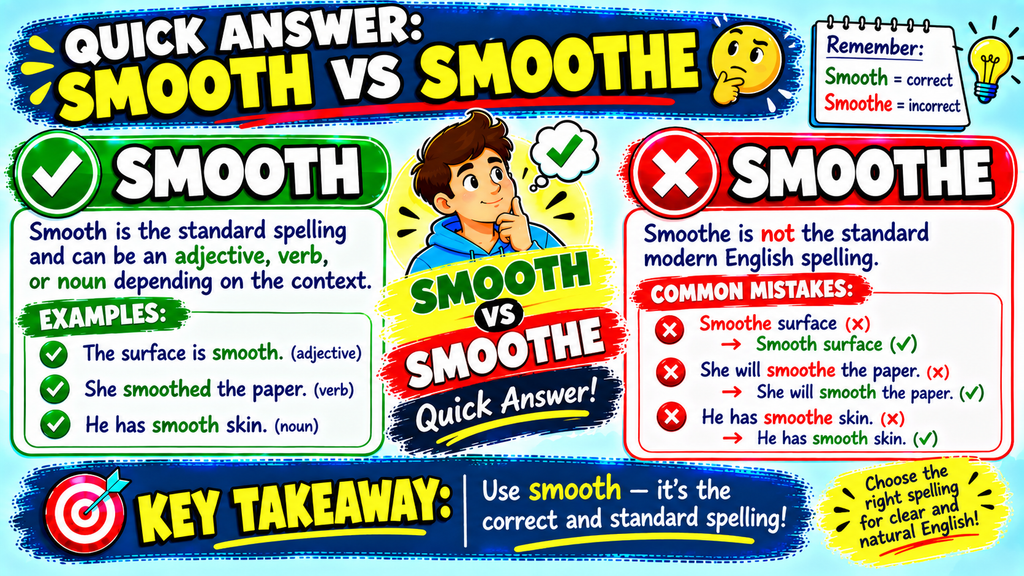
“Smooth” is the correct spelling. ✅ It works as both an adjective (a smooth surface) and a verb (to smooth the fabric).
“Smoothe” is not a standard English word. ❌ It’s a common misspelling, usually caused by confusing “smooth” with similar-looking words like “soothe” or “breathe.”
Understanding the Basics: Smooth vs Smoothe
What Does “Smooth” Mean?
“Smooth” describes something even, flat, or free of bumps and rough patches 🪶. It can also describe an easy, trouble-free process, like a smooth flight or a smooth negotiation. As a verb, it means to flatten or remove wrinkles from something.
What About “Smoothe”?
“Smoothe” doesn’t appear in Merriam-Webster, Oxford, or Cambridge dictionaries. It shows up in casual writing, social media, and even some published articles, but that doesn’t make it correct grammar. Think of it as a spelling error that has become surprisingly widespread. 📝
Comparison Table: Smooth vs Smoothe
| Feature | Smooth ✅ | Smoothe ❌ |
|---|---|---|
| Dictionary status | Standard, recognized word | Not a recognized word |
| Part of speech | Adjective & verb | None (misspelling) |
| Past tense | Smoothed | N/A |
| Third-person singular | Smooths | N/A |
| Example sentence | “She has smooth skin.” | Incorrect usage |
| Common confusion source | — | Analogy with soothe, breathe |
Correct Meanings & Uses of “Smooth”
1. Smooth as an Adjective
Used to describe texture, flow, or ease 🌊:
- The countertop felt smooth under her hand.
- We had a smooth flight from Tbilisi to London.
- His smooth voice made the podcast easy to listen to.
2. Smooth as a Verb
Used to describe the action of flattening or easing something out:
- Smooth the batter before baking.
- He tried to smooth over the disagreement.
- She smooths her hair every morning.
Conjugation table:
| Tense | Form |
|---|---|
| Base | smooth |
| Third-person singular | smooths |
| Past tense | smoothed |
| Past participle | smoothed |
| Present participle | smoothing |
Test Tip
Quick trick: if you can replace the word with “even” or “flatten out” and it still makes sense, you need “smooth” — never “smoothe.” 🎯
Case Study: Real-Life Usage Example
A well-known example comes from a major U.S. newspaper, which once ran a headline about repair work needed to “smoothen” a train ride instead of using the correct verb form. 🚆
What Happened Here?
Even professional editors sometimes let non-standard forms like “smoothen” or “smoothe” slip through, especially under deadline pressure. It’s proof that this mix-up isn’t just a beginner mistake it happens in published, edited content too. 📰
Grammar Rules Explanation
Historical Reason
English has a pattern where adding a silent “e” changes a noun into a verb with a different sound think cloth → clothe, or breath → breathe. People assume “smooth” follows the same rule. It doesn’t, because “smooth” already carries that soft “th” sound as both an adjective and a verb, so no extra “e” is needed to change its pronunciation. 🔤
Modern Rule
Every major dictionary lists “smooth” as the only accepted spelling for the adjective and verb forms. “Smoothe” simply isn’t included as a headword anywhere. 📖
Common Mistakes
Here are the errors people make most often:
- Writing “smoothe” instead of “smooth” (adjective or verb).
- Writing “smoothes” instead of “smooths” for third-person singular.
- Treating “smoothen” as fully standard English, when style guides flag it as an unnecessary variant.
Why This Mistake Happens
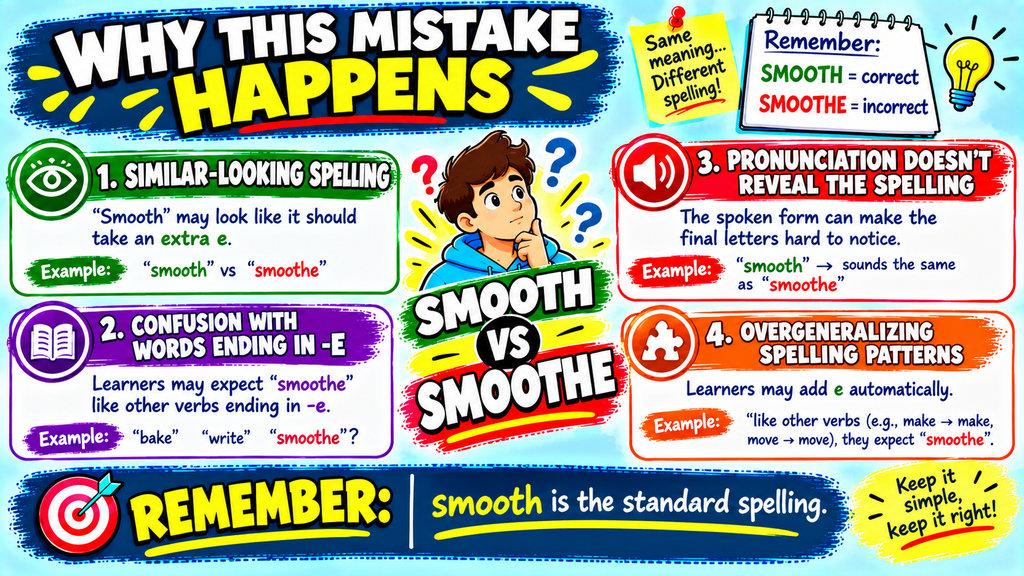
It almost always comes down to analogy. Words like soothe, breathe, teethe, and clothe all end in a silent “e,” so the brain assumes “smooth” should follow suit. 🧠 The past tense “smoothed” which does contain an “e” adds to the confusion too.
Similar Grammar Confusions
“Smooth” isn’t the only word caught in this trap. Here’s how it compares to real noun-to-verb “e” pairs:
| Noun/Adjective | Verb Form | Notes |
|---|---|---|
| Cloth | Clothe | Adds “e” to become a verb |
| Breath | Breathe | Adds “e” to become a verb |
| Bath | Bathe | Adds “e” to become a verb |
| Loath | Loathe | Adds “e” to become a verb |
| Sooth (archaic) | Soothe | Adds “e” to become a verb |
| Smooth | Smooth | No “e” needed — stays the same 🚫➕e |
This table is the real reason people trip up. Nearly every similar word does add an “e” smooth is the exception, not the rule.
Usage in Different Contexts
1. Everyday Conversation
“This smoothie is so smooth!” simple, casual, always spelled with no final “e” on the adjective. 🥤
2. Professional Writing
“We ensured a smooth onboarding process for new hires.” Business writing should always use “smooth,” never “smoothe,” to maintain credibility. 💼
3. Creative Writing ✍️
Poets and songwriters occasionally bend spelling for rhythm or style, but this is artistic license, not a grammar rule you should copy in formal writing.
4. Social Media/Texting
Typos like “smoothe” are common in quick posts and comments, largely because autocorrect doesn’t always catch it. 📱 Still worth fixing before you hit “post.”
Why It Matters (Important Section)
Spelling errors like this can quietly hurt your credibility, whether it’s a resume, a business email, or a blog post 🚩. Search engines and readers both notice consistency, so getting “smooth” right is a small but meaningful part of writing well.
Special Exception
Brand names and trademarks sometimes intentionally use “Smoothe” or similar stylized spellings for marketing purposes for example, some clothing and beauty brands have trademarked names like “Smoothez.” 🏷️ These are deliberate branding choices, not proof that “smoothe” is grammatically correct.
Quick Recap Checklist
- ✅ Use “smooth” for both adjective and verb.
- ✅ Use “smooths” for third-person singular, not “smoothes.”
- ✅ Use “smoothed” for past tense.
- ❌ Never use “smoothe” — it’s not a real word.
- ⚠️ Avoid “smoothen” in formal writing; stick with “smooth.”
Practice Examples
Try spotting the correct version:
- The lake was perfectly ______ this morning. (smooth / smoothe) → smooth
- She ______ the wrinkles out of her dress. (smooths / smoothes) → smooths
- He ______ over the awkward silence with a joke. (smoothed / smoothe) → smoothed
Frequently asked questions: Smooth vs Smoothe
Is “smoothe” a real word?
No. It’s a common misspelling of “smooth” and doesn’t appear in standard dictionaries. 📌
What is the past tense of “smooth”?
The correct past tense is “smoothed,” not “smoothe.”
Is “smoothen” correct English?
It appears in a few dictionaries but is widely considered an unnecessary variant of “smooth.” Stick with “smooth” in formal writing.
Why do people confuse smooth with smoothe?
Because similar words like breathe, soothe, and clothe all end in a silent “e,” leading to a false pattern. 🔄
Is it “smooths” or “smoothes”?
“Smooths” is correct for third-person singular present tense.
Can “smoothe” ever be used correctly?
Only as a stylized brand or trademark spelling never as standard grammar. 🚫
Conclusion
“Smooth” is the only correct spelling, whether you’re describing a silky texture or the act of flattening something out 🎉. “Smoothe” is a persistent but incorrect variant, usually born from confusion with words like soothe and breathe. Keep this guide handy, and you’ll never spell it wrong again.
