

Quick Answer: Time Has Flown By or Time Has Flew By?
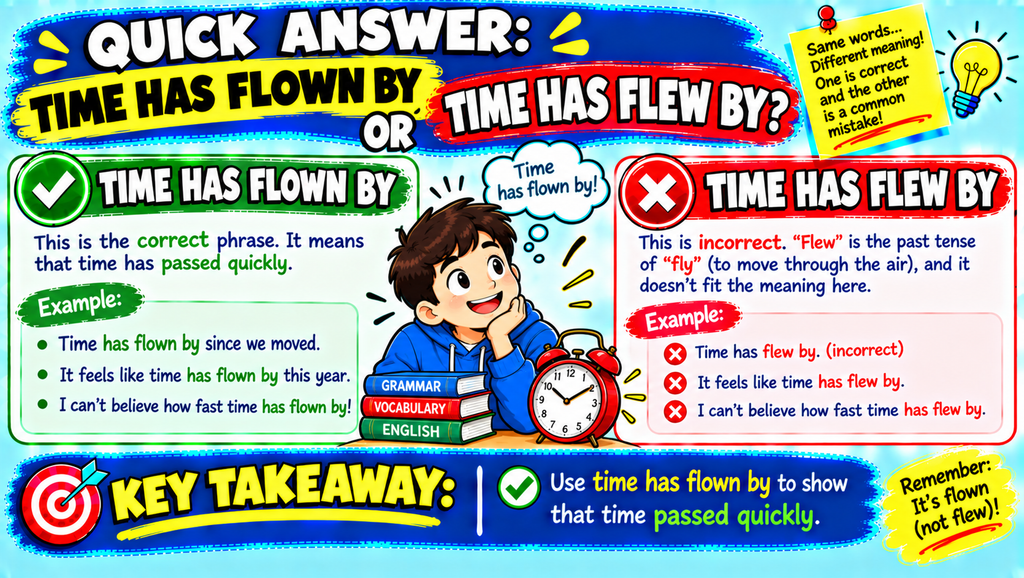
“Time has flown by” is correct. ✅ “Flown” is the past participle of “fly,” and it must follow “has,” “have,” or “had.” ✈️ “Time has flew by” is wrong because “flew” is the simple past form. ❌ If you prefer “flew,” drop the helping verb and write “time flew by.” 👍
- ✅ Correct: Time has flown by.
- ❌ Incorrect: Time has flew by.
- ✅ Also correct: Time flew by.
Understanding the Basics: Time Has Flown By or Time Has Flew By
The confusion comes from the verb “fly.” 🤔 It is an irregular verb, so it does not follow the simple “add -ed” pattern. 🧩 Instead, it changes shape in each form. 🔄
| Base Form | Simple Past | Past Participle |
|---|---|---|
| fly | flew | flown |
Notice that the second and third forms are different words. 👀 Many other irregular verbs, like “walk” or “play,” repeat the same form, so people assume “fly” does too. 😅 That assumption is where the mistake begins. 🪤
Correct Meanings & Uses
In this phrase, “fly” has nothing to do with wings. 🪽 It is a figure of speech that means time passed very quickly. ⚡ The phrase works well when you look back and feel surprised by how fast a period ended. 🔙
Understanding “Time Has Flown By”
“Time has flown by” uses the present perfect tense. 🧠 This tense links something that happened in the past to the present moment. 🔗 That is why the phrase fits so well in reflections, farewells, and updates. 💬
- The summer has flown by, and school starts on Monday. ☀️
- Time has flown by since we last met. 🤝
Another Example
The phrase also works with plural subjects, where “has” changes to “have.” 🔁 The verb “flown” stays exactly the same. 🔒
- Ten years have flown by since graduation. 🎓
- Has the week flown by for you too? 📅
Test Tip
Here is a quick trick to check yourself. 🧪 Swap “fly” with “go” and see what sounds right. 🔍 You would say “time has gone by,” never “time has went by.” 🚫 In the same way, “time has flown by” is right, and “time has flew by” is not. ✅
Understanding Why “Time Has Flew By” Is Wrong
The problem is structural, not stylistic. 🏗️ “Has” is a helping verb, and it needs a past participle right after it. 🧱 “Flew” is a simple past verb, so it cannot take that position. 🙅
| Sentence | Verb Form | Verdict |
|---|---|---|
| Time has flew by. | has + simple past | ❌ Incorrect |
| Time has flown by. | has + past participle | ✅ Correct |
| Time flew by. | simple past alone | ✅ Correct |
In short, “flew” works alone, and “flown” needs a helper. 🤝
Case Study Section
Here is an illustrative scenario, not a real company report. 📝 Imagine a project manager who sends a quarterly update to a client. 💼
Original line: “I can’t believe this quarter has flew by!”
The client understands the message, but the error stands out in an otherwise polished email. 👁️ A small slip like this can make a careful writer look rushed. ⏱️
Fixed line: “I can’t believe this quarter has flown by!”
The corrected sentence reads smoothly and keeps the focus on the update itself. 🎯 The lesson is simple: one wrong verb form can distract from a strong message. 💡
Grammar Rules Explanation
Four short rules cover almost every case. 📚
- The present perfect uses has/have + past participle. ⏳
- The past perfect uses had + past participle. ⏪
- The simple past stands alone, with no helping verb. ☝️
- Never pair a helping verb with a simple past form. 🚫
| Tense | Formula | Example |
|---|---|---|
| Simple past | subject + flew | Time flew by last summer. |
| Present perfect | subject + has/have + flown | Time has flown by this year. |
| Past perfect | subject + had + flown | Time had flown by before we noticed. |
If you spot “has,” “have,” or “had,” your brain should reach for “flown.” 🧲
Common Mistakes
Most errors are slips rather than a lack of intelligence. 🙂 Here are the four usual causes. 🔎
Fast typing
When you type quickly, your fingers often reach for the form you use most. ⌨️ “Flew” is more common in daily writing, so it sneaks in. 🕵️
Autocorrect
Autocorrect checks spelling, and “flew” is a real word. 📱 Because of that, the tool rarely flags the mistake. 🤖
Lack of grammar knowledge
Many learners never memorize the three forms of irregular verbs. 🧠 They default to the simple past and hope it fits. 🎲
Similar sounds
“Flew” sounds like “flu” and “flue,” which adds to the mix-up. 👂 “Flown” is also rarer in speech, so it feels less familiar. 🗣️
Similar Grammar Confusions
The same trap appears with many other irregular verbs. 🪤 Learning one pattern helps you fix them all. 🧩
| Wrong | Correct |
|---|---|
| has went | has gone |
| has swam | has swum |
| has drank | has drunk |
| has wrote | has written |
| has took | has taken |
| has began | has begun |
| has saw | has seen |
The fix is always the same: use the past participle after “has,” “have,” or “had.” 🔧
Usage in Different Contexts
Everyday Conversation
In casual talk, “time has flown by” sounds warm and natural. 💬 Try it when you meet an old friend: “It’s been years, and time has flown by.” 👋
Professional Writing
In emails, reports, and presentations, accuracy builds trust. 🏢 A line like “The year has flown by, and our team delivered every milestone” sounds confident and clean. 📈
Creative Writing ✍️
Fiction writers use this phrase to show a time jump without a long explanation. 📖 For example, “Autumn had flown by, and the first snow was already falling” moves the story forward fast. ❄️
Social Media and Texting
Casual posts are more forgiving, but correct grammar still looks sharp. 📲 A caption such as “This weekend has flown by!” works perfectly. 🎉
Why It Matters
Clarity
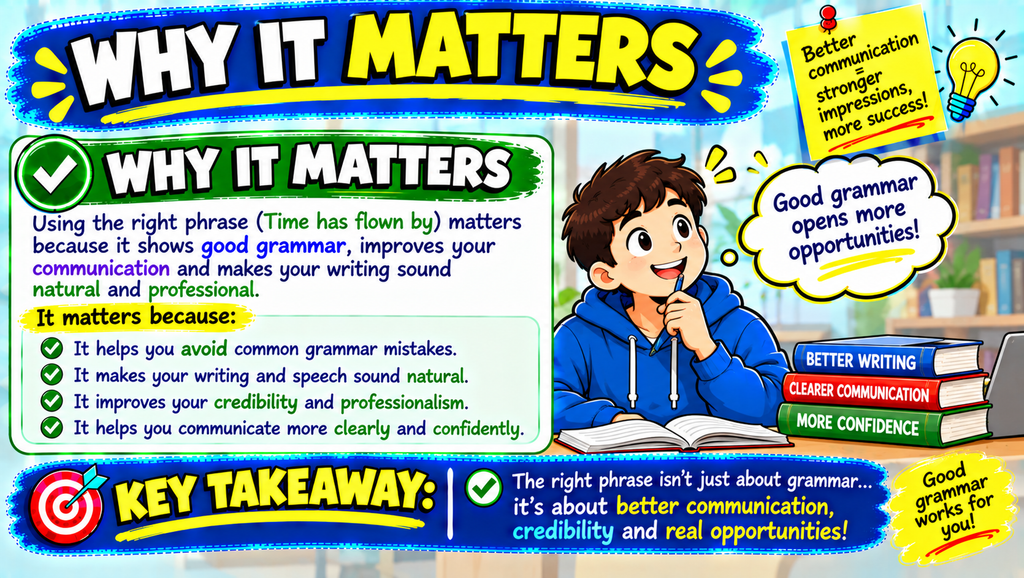
Correct verb forms keep your meaning clear. 🔍 Readers never have to stop and wonder what you meant. 🙌
Professionalism
Clean grammar signals care and credibility. 🏅 It matters most in resumes, emails, and client messages. 📧
Writing accuracy
Getting small details right builds strong habits. 🧱 Over time, those habits make all your writing better. 🌱
Special Exception
There is no situation where “has flew” is standard English. 🚫 However, “flew” is perfectly fine on its own, as in “Time flew by.” ✅ A few related cases are worth knowing too. 📌
- “Flown” can describe language that is overly grand, as in “high-flown speech.” 🎭
- In baseball, “fly out” takes a regular past tense, so you hear “he flied out to center.” ⚾
- Some regional dialects use “has flew” in speech, but it is still considered nonstandard in writing. 🗺️
Quick Recap Checklist
- ☑️ Look for “has,” “have,” or “had” before the verb.
- ☑️ If you see one, use “flown.”
- ☑️ If there is no helping verb, use “flew.”
- ☑️ Remember the chain: fly → flew → flown.
- ☑️ Try the “go” test: has gone, not has went.
- ☑️ Proofread, because autocorrect will not catch this one.
Frequently Asked Questions
Which is correct: time has flew by or time has flown by?
“Time has flown by” is correct. ✅ “Flown” is the past participle that must follow “has.” 🧩
What is the difference between flew and flown?
“Flew” is the simple past and stands alone. ✈️ “Flown” is the past participle and follows “has,” “have,” or “had.” 🤝
Is “time flew by” correct?
Yes, it is correct simple past tense. 👍 Use it for a finished period, like “Time flew by last summer.” ☀️
Is “time has flew by” ever acceptable?
No, it is not acceptable in standard English. 🚫 It may appear in casual speech, but you should avoid it in writing. ✍️
What tense is “time has flown by”?
It is the present perfect tense. ⏳ The formula is has/have + past participle. 📐
Is “time flies by” correct?
Yes, “time flies” and “time flies by” are both common and correct in the present tense. ✅ Use them for general truths, such as “Time flies when you’re having fun.” 🎈
Can I say “the years have flown by”?
Yes, with a plural subject you use “have” instead of “has.” 🔁 “Flown” stays the same. 🔒
Conclusion
So, time has flown by or time has flew by? The answer is clear: “time has flown by” is the correct choice. 🎯 “Flown” is the past participle, and helping verbs like “has,” “have,” and “had” always need one. 🧠 Use “flew” only when the verb stands alone, as in “time flew by.” ✅ Keep the fly → flew → flown chain in mind, and you will never second-guess this phrase again. 🚀 Share this guide with a friend who still writes “has flew,” and help them polish their grammar too. 💌
