

If you’ve ever stared at a grocery list wondering whether it’s “tomatoes” or “tomatos,” you’re dealing with one of English’s sneakiest spelling traps. It looks like it should just take an “-s,” but the correct answer breaks that expectation entirely. Here’s the definitive answer, plus the grammar logic behind it. 🧠
Quick Answer: Tomatoes or Tomatos
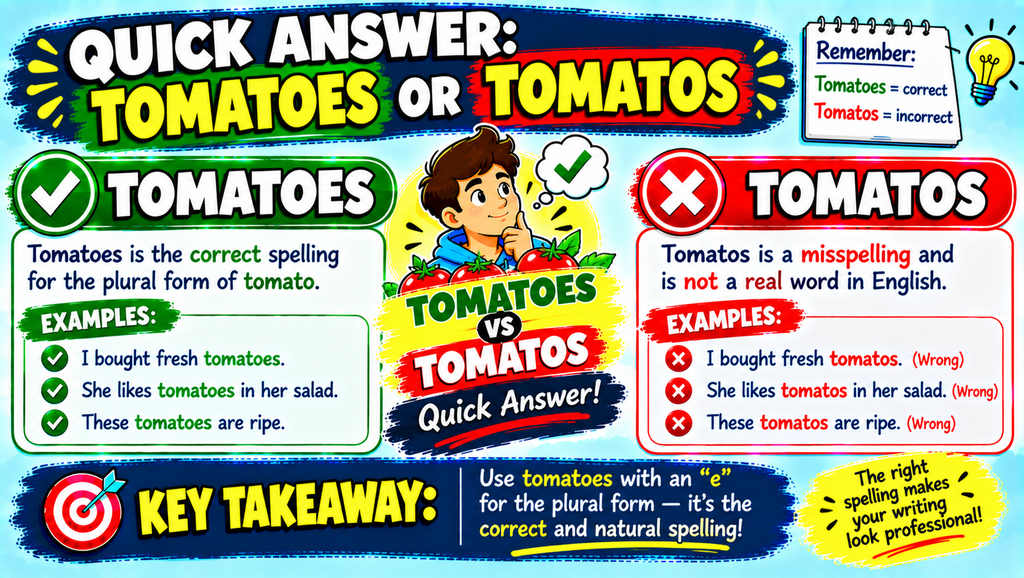
“Tomatoes” is the only correct spelling. “Tomatos” is a common misspelling that ignores a specific English pluralization rule for words ending in a consonant plus “o.” No major dictionary, style guide, or grammar authority recognizes “tomatos” as an accepted alternative.
Understanding the Basics (Tomatoes or Tomatos)
English usually pluralizes nouns by simply adding “-s,” but a specific group of words ending in “o” breaks that pattern and takes “-es” instead. “Tomato” belongs firmly in that group. 🍅
Key Idea
When a word ends in a consonant + o (like tomato, potato, or hero), the plural typically adds “-es.” When a word ends in a vowel + o (like radio or video), the plural usually just adds “-s.” This single distinction explains almost the entire confusion.
Correct Meanings & Uses
1. What Does “Tomato” Mean?
“Tomato” is the singular noun referring to one round, typically red fruit (botanically a fruit, culinarily treated as a vegetable) used widely in cooking. Example: “Add one ripe tomato to the sauce.”
2. What Does “Tomatoes” Mean?
“Tomatoes” is the plural form, referring to two or more of the fruit. Example: “The recipe calls for three chopped tomatoes.”
Test Tip
If you’re unsure, compare it to “potato.” Since everyone agrees “potatoes” (not “potatos”) is correct, and both words follow the identical spelling pattern, “tomatoes” must follow suit too. ✅
Case Study Section
Real-Life Example: Grocery Store Conversation
Shopper: “Do you have any fresh tomatoes today?”
Clerk: “Yes, we just got a new batch of Roma tomatoes in this morning.”
Notice both speakers naturally use “tomatoes,” never “tomatos” a clear sign of how deeply the correct spelling is embedded in everyday native speech, even when people aren’t consciously thinking about grammar rules.
Why It Matters
Spelling “tomatoes” incorrectly as “tomatos” in a recipe blog, restaurant menu, or professional email can quietly undercut your credibility, especially in food, hospitality, or content writing where attention to detail matters.
Grammar Rules Explanation
Why Not Just Add “-s”?
English pluralization for “-o” endings isn’t random it’s rooted in pronunciation history. Adding just “-s” to a consonant-plus-“o” word can create awkward-sounding endings, so English speakers historically inserted an “e” before the “s” to keep the word flowing naturally. Over centuries, this became the standardized spelling for words like “tomato,” “potato,” “hero,” and “volcano.”
| Singular | Correct Plural | Incorrect Plural | Rule Applied |
|---|---|---|---|
| Tomato | Tomatoes | Tomatos | Consonant + o → add -es |
| Potato | Potatoes | Potatos | Consonant + o → add -es |
| Hero | Heroes | Heros | Consonant + o → add -es |
| Volcano | Volcanoes | Volcanos | Consonant + o → add -es |
| Photo | Photos | Photoes | Exception: vowel-adjacent/loanword → add -s |
| Piano | Pianos | Pianoes | Exception: vowel + o → add -s |
Common Mistakes Section
Why Do People Write “Tomatos”?
- They default to the simpler, more common “-s” pluralization rule that applies to most English nouns.
- Autocorrect or casual typing habits reinforce the shorter, incorrect form over time.
- Some product packaging and informal signage misspells it, creating false familiarity with the wrong version.
Similar Grammar Confusions
- Hero vs. Heros — correct plural is “heroes.”
- Potato vs. Potatos — correct plural is “potatoes.”
- Echo vs. Echos — correct plural is “echoes.”
- Photo vs. Photoes — correct plural is “photos” (an exception to the rule).
Usage in Different Contexts
1. Everyday Conversation
In casual speech, “tomatoes” is used automatically and rarely questioned most native speakers say it correctly without ever thinking about the underlying rule.
2. Professional Writing
Menus, recipes, agricultural reports, and marketing copy should always use “tomatoes,” since misspellings here can appear careless in front of customers or clients.
3. Creative Writing ✍️
Fiction and poetry may occasionally play with spelling for stylistic or dialogue purposes, but standard narration should still default to “tomatoes.”
4. Social Media/Texting
Casual posts and captions sometimes slip into “tomatos,” but it’s still technically incorrect spellcheck tools will typically flag it even in informal settings.
Why It Matters (Important Section)
Correct spelling isn’t just about following rules for their own sake — it directly affects how your writing is perceived.
Here’s Why:
- Credibility: Correct spelling signals professionalism, especially in food, publishing, or customer-facing content.
- SEO performance: Search engines and readers both favor accurately spelled, well-optimized content over error-ridden pages.
- Avoiding confusion: “Tomatos” can look like a typo mid-sentence, disrupting the reader’s flow.
Special Exception
Not every “-o” word follows the “-es” rule — loanwords and abbreviated terms like “photo,” “piano,” “logo,” and “memo” take a simple “-s” instead. There’s no foolproof shortcut for knowing which category a word falls into; the safest approach is memorizing common words individually or checking a dictionary when in doubt. 📖
Quick Recap Checklist
- The correct plural of “tomato” is always tomatoes.
- “Tomatos” is a misspelling with no accepted use in formal English.
- Consonant + “o” words (tomato, potato, hero, volcano) typically add “-es.”
- Vowel-adjacent or loanword “-o” endings (photo, piano, logo) typically add just “-s.”
- When unsure, compare the word to “potato” as a reliable reference point.
Practice Examples
- I bought five ______ at the farmers market. (tomatoes)
- The chef diced three ripe ______ for the salsa. (tomatoes)
- Her garden grew more ______ than she could use. (tomatoes)
- Please don’t write “______” in the recipe card — use “tomatoes.” (tomatos, incorrect example)
Frequently asked questions Section
Is “tomatos” ever acceptable in English?
No, “tomatos” is not recognized as correct in any major dictionary or style guide.
Why does “tomato” get an “-es” instead of just “-s”?
Because it ends in a consonant followed by “o,” a pattern that historically takes “-es” for smoother pronunciation.
Is “tomato’s” the same as “tomatoes”?
No, “tomato’s” shows possession or a contraction, while “tomatoes” is simply the plural form.
Do British and American English spell it differently?
No, both dialects use “tomatoes” as the standard plural, though pronunciation of “tomato” itself differs slightly.
What’s an easy way to remember the correct spelling?
Link it to “potatoes” since both words share the same ending pattern and “potatoes” is rarely misspelled.
Conclusion
The rule behind “tomatoes” versus “tomatos” comes down to one small but important pattern: consonant-plus-“o” words typically take “-es” in their plural form. Keep “potatoes” in mind as your mental anchor, and you’ll never second-guess this spelling again. 🍅✅
