

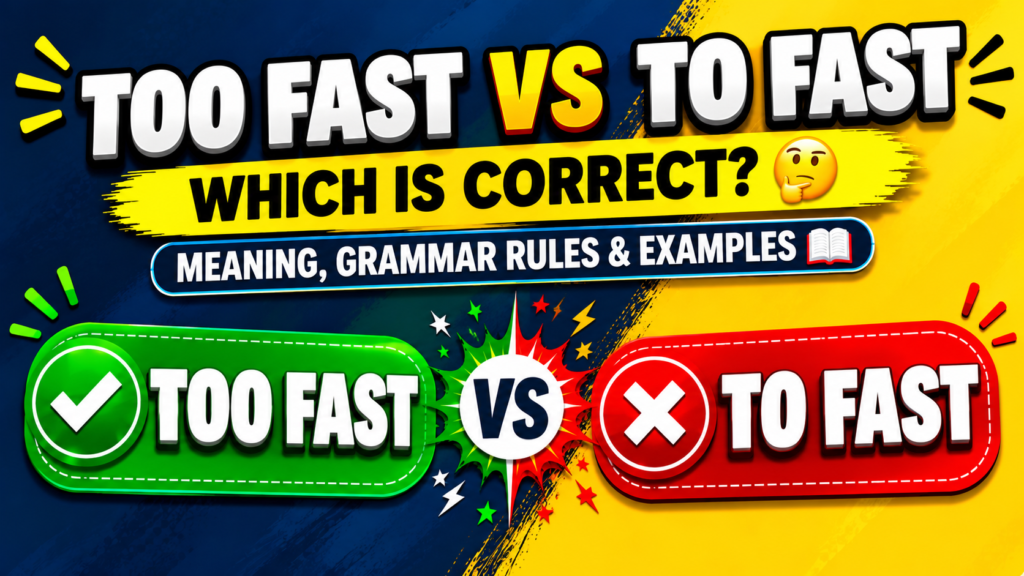
You typed it, stared at it, and then second-guessed yourself. 🤔 Is it “you’re driving too fast” or “you’re driving to fast“? This one-letter mix-up is one of the most common English writing mistakes, and it trips up native speakers just as often as learners. 🚦
The good news? Once you understand the simple rule behind it, you’ll never confuse these two again. Let’s break it down clearly, with real examples, a comparison table, and practice exercises you can use right away.
Quick Answer: To Fast Or Too Fast? ⚡
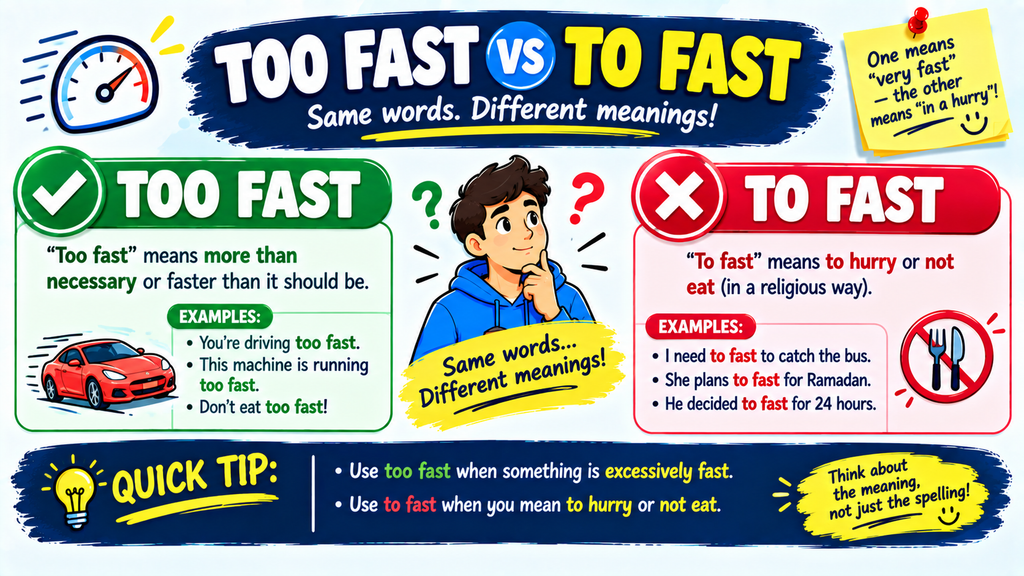
“Too fast” is almost always the correct phrase when you’re talking about speed. “Too” is an adverb meaning “excessively,” so “too fast” simply means “excessively fast.” 🏎️
“To fast,” on the other hand, is grammatically valid too — but it means something completely different. It’s the infinitive form of the verb “fast,” meaning to go without food or drink, usually for religious, medical, or personal reasons. 🍽️
So the short version: if you’re describing speed, use too fast. If you’re talking about not eating, to fast is correct.
Understanding the Basics of To Fast Or Too Fast 📖
English is full of homophones — words that sound alike but mean different things — and “to” and “too” are among the most confused. Getting this right instantly makes your writing look more polished and professional. ✨
Simple Rule
- Too = an adverb meaning “excessively” or “also” 🔹
- To = a preposition (showing direction/purpose) or the marker before a verb’s infinitive form 🔹
- If you can replace the word with “excessively” and the sentence still makes sense, use too ✅
Correct Meanings and Uses
What Does “Too Fast” Mean? 🚗💨
“Too fast” describes speed, pace, or a rate that exceeds what’s appropriate, safe, or expected. It’s used constantly in everyday speech, writing, and even warning signs. 🚧
Examples:
- He was driving too fast on the icy road. 🧊
- Don’t eat too fast, you’ll get a stomachache. 🍝
- The download finished too fast to be real. 💻
- Time seems to pass too fast during vacations. 🏖️
- She spoke too fast for anyone to follow. 🗣️
Test Tip: Swap “too” for “excessively.” If the sentence still makes sense, “too fast” is correct. 💡 (“He was driving excessively fast” ✔️)
What Does “To Fast” Mean? 🕊️
“To fast” uses “fast” as a verb meaning to abstain from eating, and “to” as the infinitive marker (like “to run” or “to eat”). It shows up in religious, medical, and health-related contexts. 🙏
Examples:
- Many people choose to fast during Ramadan. 🌙
- The doctor asked her to fast before the blood test. 🩸
- He decided to fast for 24 hours as part of his health routine. ⏰
- It’s common to fast before certain religious ceremonies. 🕯️
- She plans to fast once a week for intermittent fasting. 🍽️
Test Tip: If you can replace “fast” with another verb like “eat” or “sleep” and the sentence still works grammatically, “to fast” is correct. ✅ (“The doctor asked her to eat” ✔️ structurally)
Comparing To Fast and Too Fast: Side-by-Side 📊
| Feature | Too Fast | To Fast |
|---|---|---|
| Part of speech | Adverb (“too”) + adjective (“fast”) | Preposition/infinitive marker (“to”) + verb (“fast”) |
| Meaning | Excessive speed | To abstain from food or drink |
| Common context | Driving, sports, technology, daily life | Religion, medicine, health, dieting |
| Example sentence | “The car was going too fast.” | “She chose to fast for a day.” |
| Frequency of use | Very common | Less common, context-specific |
Case Study: Too Fast vs To Fast in Real Writing 🧾
Workplace Email Example
Imagine an employee writing to their manager about a rushed project. A common typo looks like this: ❌ “I think we moved to fast on this deadline.” The correct version should read: ✅ “I think we moved too fast on this deadline.” 📩
Why It Matters
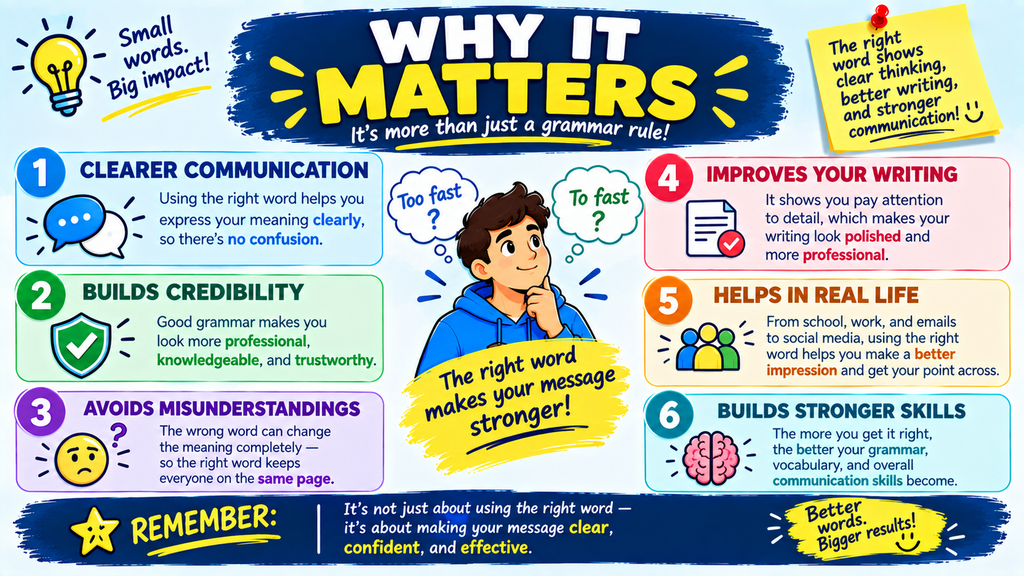
One swapped letter changes a professional email into one that reads as careless or confusing to the reader. 😬 In business communication, small grammar slips like this can quietly undermine credibility, even when the message itself is solid.
Grammar Rules Explained 📚
Why “Too Fast” Is Usually Correct
“Fast” functions here as an adjective describing speed, and adjectives describing degree (too much, too little, too fast) are almost always paired with “too,” not “to.” 🎯 This pairing follows the same pattern as “too loud,” “too slow,” and “too expensive.”
Why “To Fast” Is Usually Incorrect (In Speed Context)
“To” cannot logically attach itself to an adjective of degree — it needs a noun, pronoun, or verb to make sense. 🚫 Writing “he drove to fast” leaves the sentence grammatically broken because “to” has nothing to connect to.
Common Mistakes to Avoid ⚠️
- Writing “to fast” when describing speed instead of fasting 🚫
- Confusing “too” with “two” as well, especially while typing quickly ⌨️
- Relying entirely on autocorrect instead of proofreading manually 📱
- Mixing up “to,” “too,” and “also” in the same sentence 🔄
- Skipping a final read-through before sending an email or message ✉️
Why the Mistakes Happen 🧠
Fast Typing
When typing quickly on a phone or keyboard, fingers often skip the second “o” in “too,” turning it into “to” without you noticing. ⌨️💨
Autocorrect Issues
Autocorrect tools sometimes “fix” too fast into to fast or vice versa, especially in messaging apps that prioritize speed over accuracy. 📲
Lack of Grammar Knowledge
Many people were never taught the clear distinction between “to” and “too” beyond a quick lesson in school, so the confusion sticks into adulthood. 🎓
Similar Grammar Confusions You Should Know 🔤
| Confusing Pair | Correct Usage | Example |
|---|---|---|
| To / Too / Two | To = direction; Too = excess/also; Two = number | “I have two apples too, so I’ll give one to you.” |
| Your / You’re | Your = possession; You’re = you are | “You’re late for your meeting.” |
| Its / It’s | Its = possession; It’s = it is | “It’s clear the dog wagged its tail.” |
| Then / Than | Then = time; Than = comparison | “She’s faster than him, then she wins.” |
| Affect / Effect | Affect = verb; Effect = noun | “The rain will affect the effect of the paint.” |
Usage in Different Contexts 🌍
Everyday Conversation
In casual speech, “too fast” dominates almost every sentence about speed, from sports commentary to complaints about internet speed. 🗨️
Professional Writing
Reports, emails, and presentations demand precision, so mixing up “to” and “too” can quietly damage how polished your writing appears. 💼
Creative Writing
Fiction and poetry sometimes use “too fast” for emotional emphasis — a heartbeat racing “too fast,” a story moving “too fast” — to build tension. 📖
Social Media and Texting
Speed and brevity often win over accuracy here, which is exactly why “to fast” typos are so common in tweets, captions, and texts. 📱
Why It Matters ✍️
Clarity in Communication
Using the wrong word can genuinely confuse a reader, especially when “to fast” and “too fast” carry entirely different meanings. 🔍
Professionalism
Small grammar errors can shape how competent or careless a writer appears, particularly in résumés, cover letters, and client-facing messages. 👔
Digital Communication Accuracy
As more communication moves to chat, email, and social platforms, precise word choice helps messages get interpreted the way they were intended. 💬
“Good grammar isn’t about perfection — it’s about making sure your reader never has to guess what you meant.” 🖋️
Special Exception: When “To Fast” Is Correct 🕊️
Religious Contexts
Many faiths, including Islam, Christianity, and Judaism, use “to fast” to describe abstaining from food during specific holy periods, such as Ramadan or Lent. 🌙
Medical Contexts
Doctors frequently instruct patients “to fast” before blood tests, surgeries, or certain scans, meaning no food or drink for a set number of hours. 🩺
Quick Recap Checklist ✅
- Use too fast when talking about speed, pace, or excess 🏎️
- Use to fast only when referring to not eating or drinking 🍽️
- Test with “excessively” to confirm “too” is correct 🧪
- Test by swapping the verb to confirm “to” is correct 🔄
- Always proofread before hitting send, especially on mobile 📲
Which One Should You Use? 🎯
Ask yourself one simple question: Am I describing speed, or am I describing not eating? If it’s speed, go with “too fast.” If it’s about abstaining from food, “to fast” is your answer. This single question resolves the confusion almost every time. 💡
Practice Examples 📝
Example 1
“He ran ___ fast for the referee to catch him breaking the rule.” Answer: too fast — this describes excessive speed. ✅
Example 2
“The nurse told him ___ fast for twelve hours before the surgery.” Answer: to fast — this describes abstaining from food. ✅
Example 3
“They uploaded the video ___ fast, and it crashed the server.” Answer: too fast — again, this refers to excessive speed. ✅
frequently asked questions
Is “to fast” ever grammatically correct?
Yes, when it means abstaining from food or drink, as in religious or medical fasting. 🕯️
What’s the easiest way to remember the difference?
Remember that “too” has an extra “o” for “extra” or “excess,” while “to” is used for direction, purpose, or verbs. 🧠
Can “too” ever mean “also” in these sentences?
Yes, “too” can mean “also,” as in “She was driving too,” but this is a different use than “too fast.” ➕
Is “to fast” used in casual conversation?
Rarely — it mostly appears in religious, medical, or health and wellness contexts like intermittent fasting. 🍽️
Does autocorrect usually catch this mistake?
Not reliably — autocorrect often misses “to/too” errors because both are valid English words. 📱
Is this mistake common even among native English speakers?
Yes, it’s one of the most frequent typos in English, largely due to fast typing and similar pronunciation. ⌨️
Conclusion
The difference between “too fast” and “to fast” comes down to one small but important test: are you talking about speed, or are you talking about skipping food? 🍽️🏎️ Once that question becomes second nature, this common mix-up disappears from your writing for good. Keep the quick recap checklist handy, proofread before you hit send, and you’ll always pick the right word — fast. ✅
