

Who vs whom confuses even confident writers. 😅 One tiny letter can change how your whole sentence sounds. ✍️ The good news is that the rule is simpler than it looks. ✅ This guide explains each word, shares quick tests, and ends with a short quiz. 🎯
Who or Whom: Simple Definition
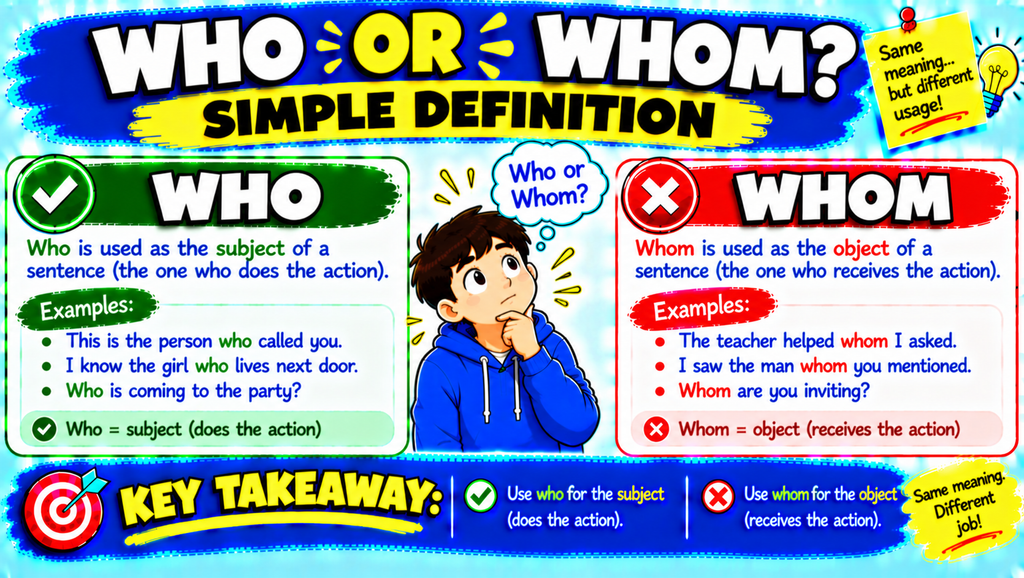
Who is a subject pronoun that names the person doing the action. 🙋 Whom is an object pronoun that names the person receiving the action. 🎁 Use who when you can replace it with he, she, or they. 👍 Use whom when you can replace it with him, her, or them. 👌
| Word | Role | Swap test | Example |
|---|---|---|---|
| Who | Subject | he / she / they | Who called you? |
| Whom | Object | him / her / them | Whom did you call? |
Is It Who or Whom?
Follow these three steps to decide in seconds. ⏱️
- Turn the question into a statement. 📝
- Replace the pronoun with “he” or “him.” 🔁
- If “he” fits, choose who. If “him” fits, choose whom. ✅
Take this one: “Who or whom wrote this email?” 📧 It becomes “He wrote this email,” so the answer is who. 🎉
When to Use Who or Whom
- Use who when the person performs the verb: Who left the lights on? 💡
- Use whom when the person receives the verb: Whom did the coach pick? ⚽
- Use whom right after a preposition: to whom, for whom, with whom. 📌
- Use who in casual speech and texts when whom feels stiff. 💬
What Does Who Mean?
Who is a pronoun for people. 👤 It works as the subject, so it usually sits before a verb. ➡️ It can also begin a clause that describes someone. 🧩
- Who is knocking at the door? 🚪
- She is the nurse who helped my father. 🏥
- I wonder who won the match. 🏆
What Does Whom Mean?
Whom is the objective form of who. 📖 It points to the person affected by an action. 🎯 You will also see it after prepositions. 📌
- Whom did you meet at the conference? 🤝
- The teacher whom I admire has retired. 🍎
- To whom did you give the keys? 🔑
Who or Whom: Core Difference
Think of who as the doer and whom as the receiver. 🧠 This table shows the full picture. 👇
| Feature | Who | Whom |
|---|---|---|
| Grammar role | Subject | Object |
| Substitute | he, she, they | him, her, them |
| After a preposition | Rare in formal writing | Standard |
| Tone | Neutral, everyday | Formal |
| Example | Who wrote it? | Whom did you ask? |
Is Who or Whom Formal or Informal?
Who works almost everywhere. 🌍 Whom sounds formal and careful. 🎩 In a text message, “Who are you meeting?” feels natural. 📱 In a report or cover letter, whom shows polish. 📄 Many native speakers drop it in conversation, and nobody blinks. 😄 Just don’t force it into casual chat, where it can sound stiff. 😬
How to Use Who Correctly
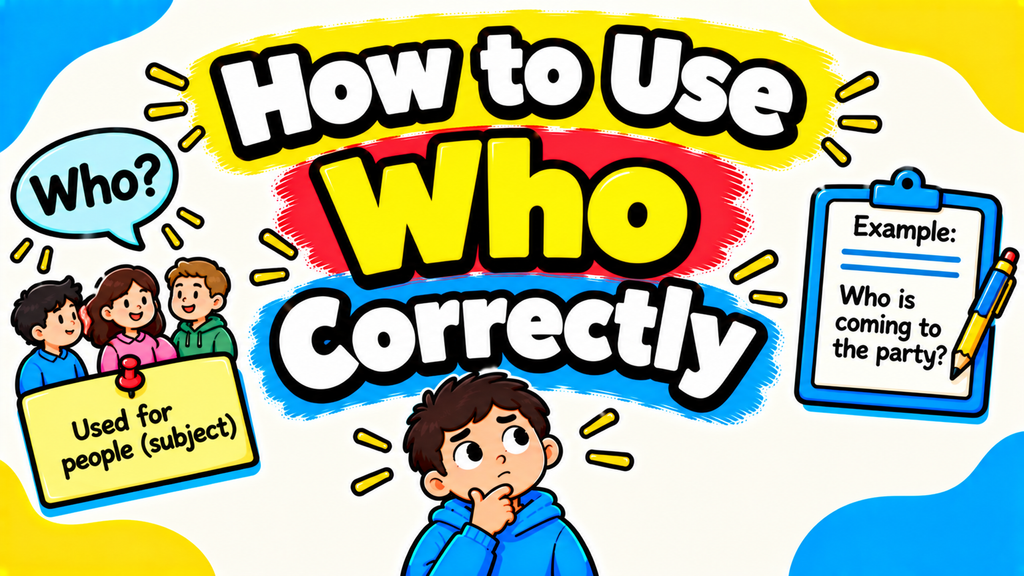
- Find the verb in the clause. 🔍
- Ask whether the person does that action. 🤔
- If yes, use who. ✅
Here are three examples:
- Who is joining us for lunch? 🥗
- The man who lives upstairs plays the piano. 🎹
- I know who broke the vase. 🏺
Watch for interrupting phrases. 👀 In “Who do you think is right?”, the words “do you think” are extra, and who is the subject of “is.” 🧐
How to Use Whom Correctly
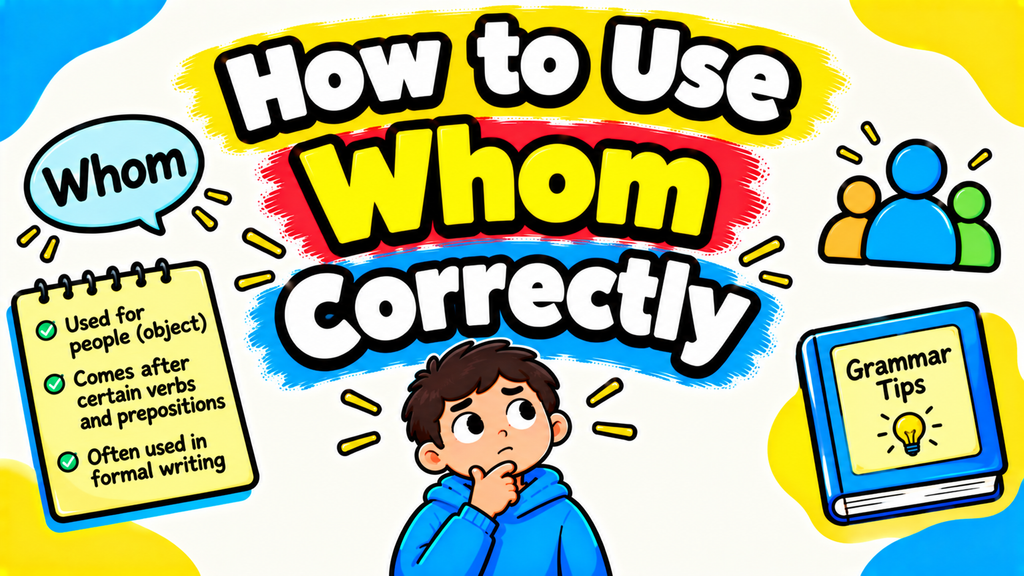
- Look for a person receiving the action. 🎯
- Or look for a preposition before the pronoun. 📌
- Test the sentence with him, her, or them. ✅
Here are three examples:
- Whom should I thank? 🙏
- The author whom we interviewed was kind. 🎤
- For whom is this gift? 🎁
Whom + To + Verb Structure
Whom often appears before “to + verb.” 🔤 In that spot, it is the object of the verb. 🎯
- I don’t know whom to call. 📞
- She asked whom to invite. 💌
- Tell me whom to trust. 🤝
In daily speech, “who to call” is very common. 🗣️ In formal writing, “whom to call” is the safer choice. ✅
Whom vs Very Formal Language Important Difference
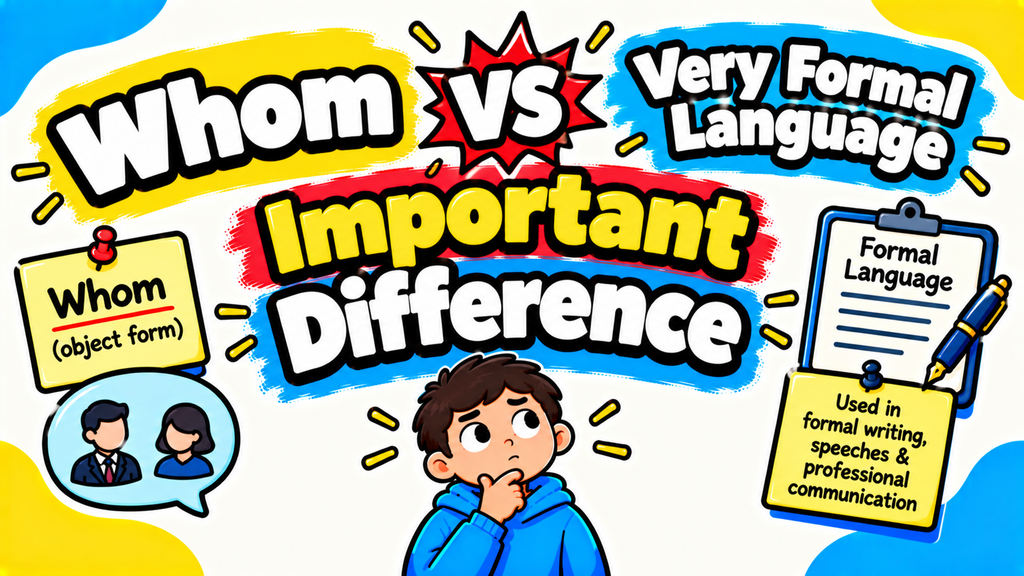
Whom signals a formal tone, but not every formal sentence needs it. 🎓 Very formal language uses it often, especially after prepositions. 📜 Think of “To whom it may concern” or “the party with whom we signed the contract.” ✍️ Overusing it in casual writing can make you sound stiff. 😬 Match the pronoun to your audience. 🎯
Whom in Questions
Formal questions use whom when the person is the object. 🎩 Test it with the answer: “I called him,” so “Whom did you call?” is correct. 📞 Questions about the doer always use who. 🙋
- Who called you? (He called me.) 📲
- Whom did you call? (I called him.) ☎️
In casual talk, “Who did you call?” is widely accepted. 💬
Common Situations Where Who or Whom Is Used
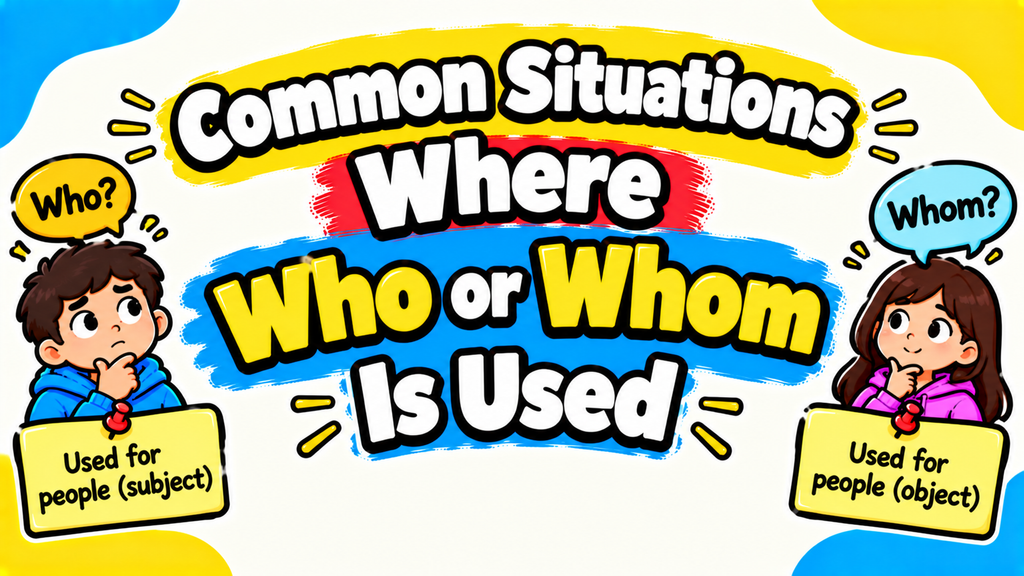
| Situation | Correct word | Example |
|---|---|---|
| Asking about the doer | who | Who made this cake? |
| Asking about the receiver | whom | Whom should I contact? |
| After a preposition | whom | With whom are you traveling? |
| Describing a doer | who | The chef who cooked dinner won. |
| Describing a receiver | whom | The chef whom we hired is great. |
| Before to + verb | whom | Whom to trust? |
Advanced Usage of Whom
Once you know the basics, these trickier cases get easy. 🚀
- Extra information: Use commas when the clause is not essential. Maria, whom I met in 2019, lives in Berlin. 🌆
- Quantities: Whom follows phrases like “some of,” “many of,” and “none of.” The students, most of whom passed, cheered. 🎉
- Whoever and whomever: Choose by the job the word does inside its own clause. In “Give the prize to whoever finishes first,” whoever is the subject of “finishes,” even though it follows “to.” 🏁
- Dropping whom: In relative clauses you can often skip it. “The woman I met” is perfectly fine. 👩
Whom with Prepositions
Prepositions take objects, so whom comes right after them. 📌 Common ones include to, for, with, by, from, about, of, among, and between. 🔗
- To whom did you speak? 🗣️
- With whom are you working? 💼
- From whom did you receive the letter? ✉️
- The friends among whom I grew up live nearby. 🏡
Informal English often moves the preposition to the end, as in “Who did you speak to?” 🙂 Both versions are accepted, but the first is more formal. ✅
Whom in Formal Writing
Use whom in essays, reports, legal documents, and business letters. 📄 It signals care and accuracy. ✅ Here is a sample: “The committee interviewed five candidates, two of whom held PhDs.” 🎓 If whom sounds clunky, rewrite the sentence. ✏️ “The client whom we served” can simply become “the client we served.” 👍
Synonyms of Whom
Whom has no exact synonyms because it is a grammatical form. 📚 These alternatives work in some situations:
- Who: common in informal speech. 🗣️
- That: works in relative clauses, as in “the man that I met.” 🤝
- Which person / what person: useful in questions. ❓
- No pronoun: “the man I met” sounds natural. 😊
Opposite of Whom
Whom has no true opposite. 🤷 Its grammatical partner is who, the subject form. 🔄 Don’t confuse either one with whose, which shows possession. 🔑
| Word | Job | Example |
|---|---|---|
| Who | Subject | Who is calling? |
| Whom | Object | Whom are you calling? |
| Whose | Possessive | Whose phone is ringing? |
| Who’s | Who is / who has | Who’s calling? |
Who or Whom Right vs Wrong
| Wrong ❌ | Right ✅ | Why |
|---|---|---|
| Whom is at the door? | Who is at the door? | Subject of “is” |
| To who did you write? | To whom did you write? | After a preposition |
| Whom do you think won? | Who do you think won? | Subject of “won” |
| The manager who we hired (formal) | The manager whom we hired | Object of “hired” |
| Whom are you? | Who are you? | Linking verb “be” |
Common Mistakes People Make
- Using whom as a subject to sound smart. This is called hypercorrection. 😅
- Skipping whom after prepositions in formal writing. 📝
- Missing interrupters like “do you think” or “I believe.” 🕵️
- Mixing up who’s and whose. 🔑
- Overusing whom in casual messages. 💬
- Forgetting that whoever and whomever follow the same logic. 🔁
Memory Trick Never Confuse Who or Whom Again
Remember the letter M. 🧠 Whom, him, and them all end in m. ✅ If him or them fits, write whom. 👌 If he, she, or they fits, write who. 🙌 Say it out loud: “He = who, him = whom.” 🎵
Quick Practice Section
Fill in who or whom. ✏️
- ___ is calling you? 📞
- With ___ did you travel? ✈️
- The teacher ___ I admire retired. 🍎
- I don’t know ___ to ask. 🤔
- ___ do you think will win? 🏆
- To ___ should I address the email? 📧
- She is the one ___ fixed the bug. 🐞
- The candidates, two of ___ were interns, applied. 💼
Answers
- Who. He is calling you. ✅
- Whom. You traveled with him. ✅
- Whom. I admire him. ✅
- Whom. Ask him. ✅
- Who. He will win, and “do you think” is extra. ✅
- Whom. Address it to him. ✅
- Who. He fixed the bug. ✅
- Whom. Two of them were interns. ✅
Who or Whom in Formal vs Informal Writing
Context decides which word sounds right. 🎯
| Context | Best choice | Example |
|---|---|---|
| Text message | who | Who are you bringing tonight? |
| Casual email | who | Who should I contact? |
| Business email | whom | To whom should I send the invoice? |
| Academic essay | whom | The participants, none of whom were paid, agreed. |
| Legal document | whom | The party to whom notice is given |
When unsure, pick the more formal option for anything you publish. ✅
Who or Whom with Specific Phrases
- To whom it may concern: always whom, since it follows “to.” 📬
- Whom to trust / who to trust: the first is the formal version. 🤝
- Who knows?: who is the subject here. 🤷
- Who’s who: an idiom for the important people in a group. 🌟
- Who are you?: after “be,” use who. 🙋
- No matter who/whom: “no matter who calls” (subject) but “no matter whom you ask” (object). ☎️
Frequently asked questions
Is it who or whom?
Use who for the subject and whom for the object. ✅ Swap in he or him to check. 🔁
What is the main difference between who and whom?
Who does the action, while whom receives it. 🎯
Can I use who instead of whom?
Yes, in casual speech and writing. 💬 Choose whom in formal writing. 🎩
How do I know when to use whom?
Use it when him, her, or them fits, or right after a preposition. 📌
Is “to whom it may concern” correct?
Yes, because whom follows the preposition “to.” 👍
Is whom disappearing from English?
It is rarer in speech, but it remains standard in formal writing. 📜
Is it “who to ask” or “whom to ask”?
Both appear in speech, but “whom to ask” is the formal choice. ✅
Conclusion
Who vs whom comes down to one idea: who does the action, and whom receives it. 🎯 Swap in he or him, and the right word shows up fast. ⚡ Use whom in formal writing and after prepositions. 📜 Use who in casual talk when whom feels stiff. 💬 Keep practicing with the quiz above, and the choice will soon feel automatic. 🚀
